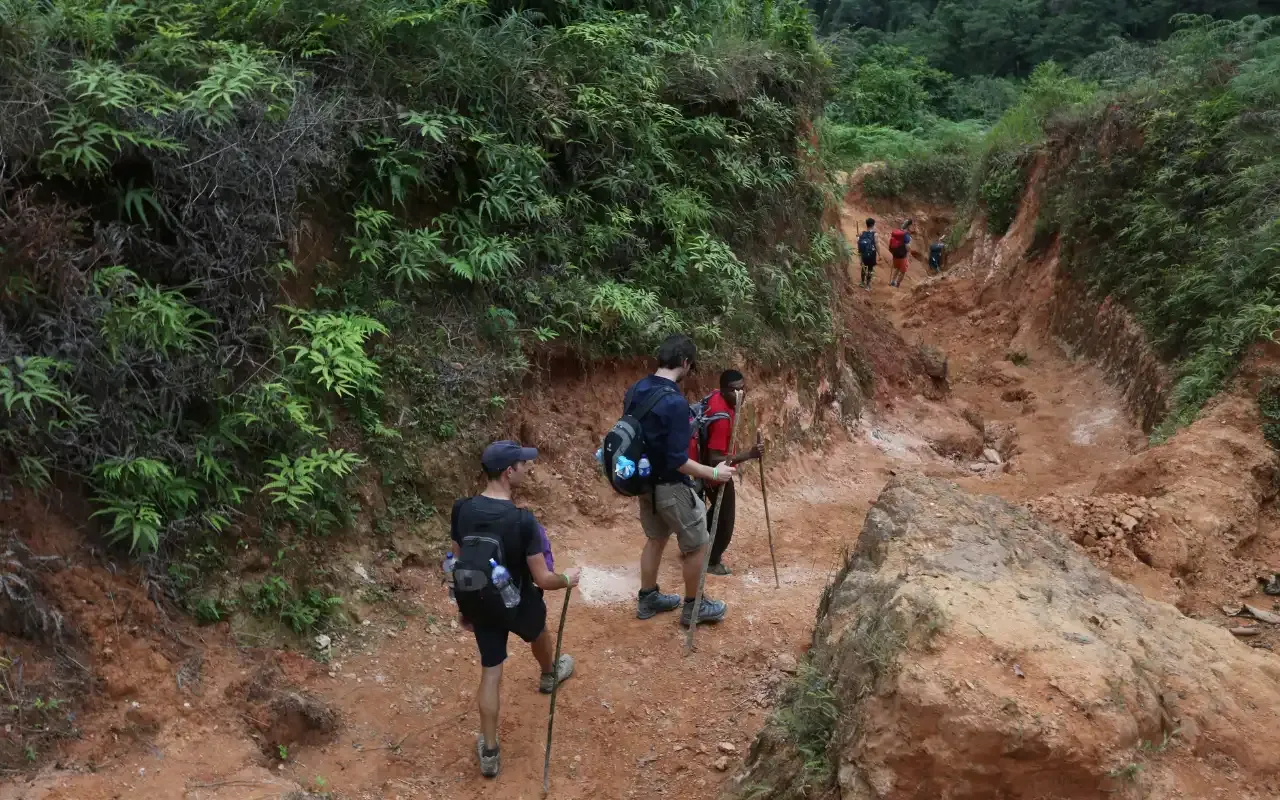
Four weeks of walking uphill with a loaded pack will change this trek more than years in a gym. That is not a slogan — it follows from what the trek actually demands, which is specific and unglamorous.
What you are training for
Work backwards from the days themselves:
| Demand | Where it comes from |
|---|---|
| 6–7 hours walking, 3 days in a row | Every day except the first |
| 8–10 kg on your back | Your daypack with water and rain gear |
| A long climbing day | Day two, 17.2 km |
| One hour of continuous stairs | The 1,200 steps on summit morning |
| A long descending day | Day four, the exit |
| 28–32 °C and humid | Every single day |
Notice what is not on that list: altitude, technical skill, running speed, upper-body strength. Teyuna sits at about 1,209 m. There is nothing to acclimatise to and nothing to climb with your hands.
The one thing nearly everybody gets wrong
They train uphill and ignore downhill.
The climb is what people imagine, so it is what they prepare for. But the day that ends treks early is day four: 17.2 km of descent, and descending loads your knees and quadriceps in a way that going up simply does not. Add mud from May to November and it takes longer still.
If you do one thing differently after reading this, make it walking downhill with weight on your back, deliberately, before you come.
The four-week plan
The whole plan is walking. If you already run or hike regularly, keep doing that and add the loaded hill work.
Week 1 — get the pack on your back
- 3 walks of 60–90 minutes, carrying 5 kg
- Find hills. Flat walking does not transfer.
- Wear the shoes you will actually bring
Week 2 — add weight and time
- 2 walks of 90 minutes with 8 kg
- 1 longer walk of 3 hours with 8 kg
- Start descending deliberately: find something to come down
Week 3 — the closest thing to the real thing
- 2 walks of 2 hours with 10 kg
- 1 long day of 4–5 hours with 10 kg, hilly
- Add stairs. Twenty minutes continuous, any staircase, once this week
Week 4 — back-to-back days, then taper
- A long walk on Saturday and another on Sunday. This is the single most useful session in the plan, because the trek’s difficulty is repetition, not any one day
- Then ease off. Nothing heavy in the final three or four days
- Do not break in new shoes this week
Training for heat you cannot practise in
If you live somewhere cool, you cannot replicate 30 °C and high humidity — and fitness built in a cool climate does not fully transfer. What you can do:
- Walk in the warmest part of your day rather than the pleasantest.
- Over-dress slightly on training walks to raise your working temperature.
- Practise drinking on the move. Most people under-drink on the trail because stopping feels like losing time. Learn to drink while walking.
- Use electrolytes on long sessions, not just water, so it is a habit before it matters.
Arrive a day or two early on the coast if you can. Even one day of acclimatising to the humidity in Santa Marta helps.
What to break in
- Your shoes. Almost every blister on this trail traces back to footwear that was new, wrong, or wet in a way it could not handle. Trail runners that drain beat waterproof boots that fill.
- Your pack. Hot spots on your shoulders and hips show up at hour four, not hour one.
- Your socks. Whatever combination works for you, prove it before you come.
If you have four weeks and no base at all
Do not panic — but do not expect the 5-day to fix it either. Its first three days are the 4-day’s, 17.2 km stage included. What it buys is a shorter exit. Four weeks of loaded hill walking will do more for you than the extra day will.
Note that on the 3-day and the 4-day the exit is the long day, and it is not a pure descent — the Sierra undulates the whole way back. The 5-day finishes differently: a waterfall route on day four, and about three hours out on day five.
If you are already fit
You still want three things: the pack on your back, downhill volume, and back-to-back days. Marathon runners and cyclists both routinely find day four harder than they expected, because neither sport loads the knees the way a long descent under weight does.
Poles
If you have any doubt about your knees, bring them. They matter most on the 1,200 steps and on the exit, and they are the cheapest insurance on this trek. Practise with them at home — using poles badly is worse than not using them.
Related
- Lost City trek difficulty — the days you are training for
- Lost City trek for beginners — if this is your first multi-day trek
- What to pack — the 8–10 kg you are training with
- 3 vs 4 vs 5 days — matching the duration to your legs
- Bunkuany — 8 km on the short version, if the 60 are not this year
Ready to walk it?
Departures leave Santa Marta at 7:00 a.m. every day. The 4-day trek has no minimum group — it runs whether you are five people or one.
From COP 1,860,000 4 days — the classic