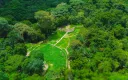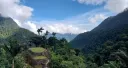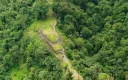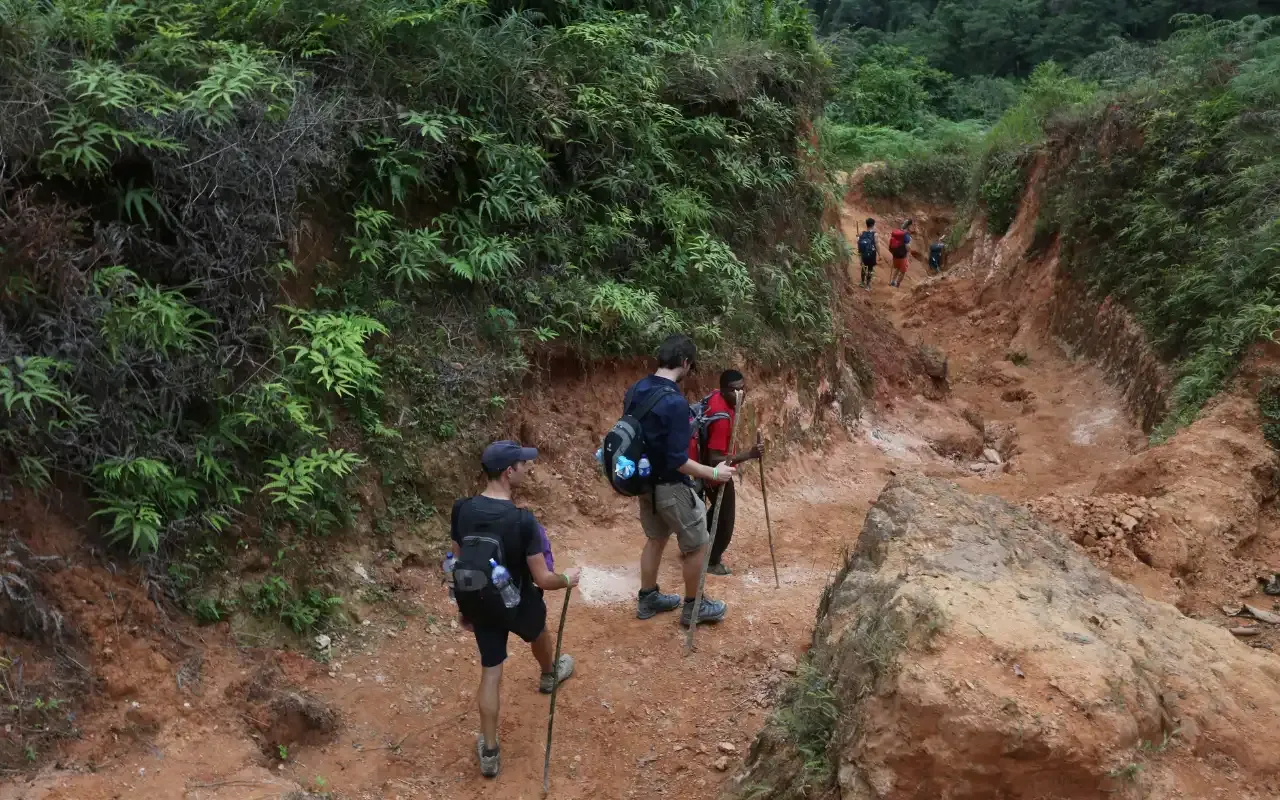
The Lost City trek is moderate, with one demanding day. It is not technical: no ropes, no climbing, no altitude problem. What it asks is that you walk 4 to 7 hours a day depending on the stage, three to five days in a row, on uneven ground, in tropical heat and humidity, carrying 8–10 kg. The single hardest element is 1,200 stone steps on summit morning — roughly an hour of continuous climbing.
If you can do a long hilly day-hike and get up and do it again the next morning, you can do this trek. If your exercise is flat urban walking, the honest answer is that you will suffer, and the 5-day is the version to book.
Difficulty at a glance
| Factor | Level | Why |
|---|---|---|
| Overall | Moderate | 5–8 hours walking most days |
| Hardest day | Hard | 1,200 steps, plus heat |
| Technical skill | None required | No ropes, no exposure, no scrambling |
| Altitude | Not a factor | Teyuna sits at ~1,209 m |
| Heat and humidity | High | 28–32 °C, humid year-round |
| River crossings | Variable | Hip-deep after rain |
| Pack weight | 8–10 kg | Mules can carry more, on request |
Altitude is the one people worry about for no reason. At 1,209 m there is no acclimatisation, no altitude sickness, no thin air. The Inca Trail tops out near 4,200 m; this is a different kind of hard — heat and repetition, not oxygen.
Day by day, with the real numbers
This is where the three durations actually differ. Same trail, same terraces — very different daily loads.
4 days
| Day | Route | Distance | Hours |
|---|---|---|---|
| 1 | Santa Marta → El Mamey → Adán | 9.3 km | 4 h |
| 2 | Adán → Múmake → Paso Lorenzo | 17.2 km | 7 h |
| 3 | Paso Lorenzo → the terraces → Múmake | 15.8 km | 6 h |
| 4 | Múmake → El Mamey → Santa Marta | 17.2 km | 6 h |
Day 1 is a genuine warm-up: 9.3 flat, humid kilometres and three river crossings. Day 2 is the hardest walking day — 17.2 km of steady climbing, on stone, root and at times the dry bed of the Buritaca river. Day 3 is short in distance but contains the steps. Day 4 is the one nobody prepares for: 17.2 km of descent, and downhill is what wrecks knees.
3 days
| Day | Route | Distance | Hours |
|---|---|---|---|
| 1 | Adán → Paso Lorenzo | 17.2 km | 7 h |
| 2 | Paso Lorenzo → the terraces → Múmake | 15.8 km | 6 h |
| 3 | Múmake → El Mamey → Santa Marta | 17.2 km | 6 h |
The 3-day is not “the same trek, faster”. It is front-loaded: day one is 17.2 km where the 4-day gives you 9.3, and pickup is at 04:30 rather than 07:00. A stretch by motorcycle on dirt road shortens the walk in. On day two you climb the 1,200 steps alongside the 4-day group, which joins the route there — but there is no rest day built in anywhere.
What it does not require is a group. Our 3-day confirms on its own terms, like the 4-day, so the constraint is your legs and the 04:30 start rather than how many people booked.
5 days
| Day | Route | Distance | Hours |
|---|---|---|---|
| 1 | Santa Marta → El Mamey → Adán | 9.3 km | 4 h |
| 2 | Adán → Múmake → Paso Lorenzo | 17.2 km | 7 h |
| 3 | Paso Lorenzo → the terraces → Múmake | 15.8 km | 6 h |
| 4 | Múmake → the waterfall route | 11.5 km | 5.5 h |
| 5 | The waterfall route → El Mamey → Santa Marta | 8 km | 3 h |
The 5-day walks the same first three days as the 4-day. What the extra night buys is the exit: 8 km and about three hours, against 17.2 km and six.
The thing nobody tells you about the 5-day
The exit day is not the same on all three. On the 3-day and the 4-day the last day is the long one, and it is not a pure descent either — the Sierra undulates the whole way back, so you go down, then up, then down again on tired legs. The 5-day is the exception: its fourth day is a separate waterfall route through mostly flat forest, and its last day is around three hours to El Mamey.
Booking the 5-day buys you a much easier ascent — but it does not buy you an easier finish. If your concern is knees rather than stamina, the extra day does not solve it. Trekking poles and a slow, deliberate descent do.
That is worth knowing before you pay, and it is the kind of thing an itinerary page tends to leave out.
The 1,200 steps
The final approach to Ciudad Perdida is a stone staircase built into the mountainside — roughly one hour of continuous up. The steps are uneven, mossy in the wet, and steeper than photographs make them look. They are not exposed: there is no drop that will frighten you, no scrambling, nothing to hold on to but the hillside.
Most people find them easier than they feared and slower than they expected. Go early, go slow, and stop when you want rather than when the group does. Poles help more here than anywhere else on the route.
Heat, humidity, mud and rivers
The Sierra Nevada is tropical: 28–32 °C by day, humid the whole year. This is what actually makes the trek hard, and it is why fitness measured on a cool European hill does not transfer directly.
Rain is common from May to November. When it rains the trails turn to mud, the river crossings swell and the final descent gets slower. The operator does not cancel a trek for rain — the trek runs in all conditions, so plan for wet rather than hope for dry. Bring a real rain jacket, two dry bags for electronics and documents, and quick-dry clothing.
River crossings are guided. Wait for your guide, unbuckle your hip belt before you step in, and cross where you are told rather than where it looks shallow.
Can you do it? An honest self-test
Yes, if you can:
- Walk up to 7 hours on uneven ground, three or four days in a row
- Carry 8–10 kg including water and rain gear
- Manage a continuous hour of stairs without needing to stop for long
- Handle heat — this is the one people underestimate most
Book the 5-day, or reconsider, if you:
- Have untreated knee or ankle problems (the descent is the test, not the climb)
- Rarely exercise beyond flat walking
- Struggle in humidity
- Want margin for photography, conversation or rain
Beginners finish this trek every week. Preparation matters more than experience — four weeks of loaded hill walking changes the trek more than years of gym work. See the training guide. And if the honest answer is that this is not the year, the Sierra has a shorter door: Bunkuany runs one, two or three days, and the one-day is 8 km to Tayrona terraces and back in Santa Marta the same night.
What if you cannot finish?
Ask this before you book, of any operator. Evacuation is on foot or by mule to road access — it is slow and weather-dependent, and there is no hospital on the trail. Trek insurance for the hiking days is included in the price; travel insurance with medical evacuation is a separate thing and worth having.
Tell your guide early if something is wrong. A blister reported at kilometre three is a blister; the same blister reported at camp is tomorrow’s problem.
Making it easier
- Book the duration that matches your legs, not your calendar. The 4-day is the balanced default; the 5-day is the gentler climb.
- Send a bag on a mule. Optional and arranged on request. Carrying 5 kg instead of 10 changes the descent completely.
- Bring poles. Most useful on the steps and on the long descent out.
- Train downhill, not just uphill. Almost nobody does this, and the last day is where it shows.
- Break in your footwear. Trail runners that drain beat waterproof boots that fill up.
Related
- 3 vs 4 vs 5 days — choosing the duration
- Training for the Lost City trek — the four-week plan
- What to pack — the 8–10 kg you carry
- Lost City trek price — what it costs and what is included
Ready to walk it?
Departures leave Santa Marta at 7:00 a.m. every day. The 4-day trek has no minimum group — it runs whether you are five people or one.
From COP 1,860,000 4 days — the classic