You carry 8–10 kg on your own back for four days, in 28–32 °C and humidity, across rivers you wade through. Everything on this list earns its weight against that sentence.
Your main bag stays behind in Santa Marta, at your hotel or at our office, and only a daypack goes on the trail. If you want to carry even less, a pack mule can take a bag for a fee, arranged on request when you book — and carrying 5 kg instead of 10 changes the last day completely.
Footwear — the decision that matters most
Trail runners beat boots for most people out here. You will cross rivers on foot, and shoes that drain and dry fast are worth more than a waterproof membrane, because a waterproof boot that fills with water stays full.
- Break them in before you come. The trail is not the place to discover a hot spot.
- A second pair of socks for camp. Dry feet in the evening is a genuine morale item.
- Sandals or crocs for camp and for showers. Light, and your feet will thank you.
Whatever you choose, it needs grip. From May to November the trail is mud, and the final 17.2 km descent is where grip stops being theoretical.
Clothing — synthetics, not cotton
The Sierra holds heat and moisture even when it rains, so the rule is short: cotton stays wet, synthetics and merino do not.
- Two quick-dry shirts. One to walk in, one to sleep in. Do not bring four.
- One long-sleeve layer, for sun on exposed sections and insects at dusk.
- Two pairs of shorts or light trousers.
- A real rain jacket. Not a poncho, not a windbreaker. It rains hard here and the trek does not stop for it.
- Something dry and warm for camp. Nights are not cold, but you will be damp.
- Swimwear. There are swimming spots, and you will want them.
The five things people wish they had brought
- Two dry bags. One for electronics, one for documents and a change of clothes. Rain and river crossings both get into a backpack.
- A headlamp. Light at camp is solar where there is any, and not guaranteed at every camp, and summit morning starts before dawn on every duration.
- A 10,000+ mAh power bank. Outlets are few, often one per dormitory area, and live only where a camp has power. Do not count on charging.
- Trekking poles. Most useful on the 1,200 steps and on the long descent out. If you have any doubt about your knees, this is the item.
- Small bills. Tips run COP 50,000–100,000 per trekker, and there is nowhere on the trail to change a COP 50,000 note. Take the cash out before you leave the city.
Essentials
- Two to three litres of water capacity. You can refill drinking water at the camps; you need to be able to carry it between stops.
- Insect repellent, for the mosquitoes at dusk and especially at camp.
- High-SPF sunscreen. The canopy is not continuous.
- Toilet paper and biodegradable toiletries. Camps have shared toilets and cold showers, and nothing is supplied.
- A small first-aid kit: blister plasters, pain relief, rehydration salts. Blisters are the most common problem on this trail by a wide margin.
- A quick-dry towel.
- Your passport. You need it at the office and on the trail.
What to leave in Santa Marta
- Your main bag. Hotel or our office, either is fine.
- Anything valuable you are not willing to carry.
- A drone you have not cleared with us. Indigenous territory and the archaeological zone both need permission in advance, and flying one without it risks confiscation and a fine. Ask when you book, not at the trailhead.
- Jeans, and anything cotton-heavy. They will be wet by lunchtime on day one and stay wet.
- A hairdryer, a book you will not read, the third pair of shoes. Every one of those is weight on a 900-metre descent.
What is already provided
You do not need to bring any of these, because they are included in the price:
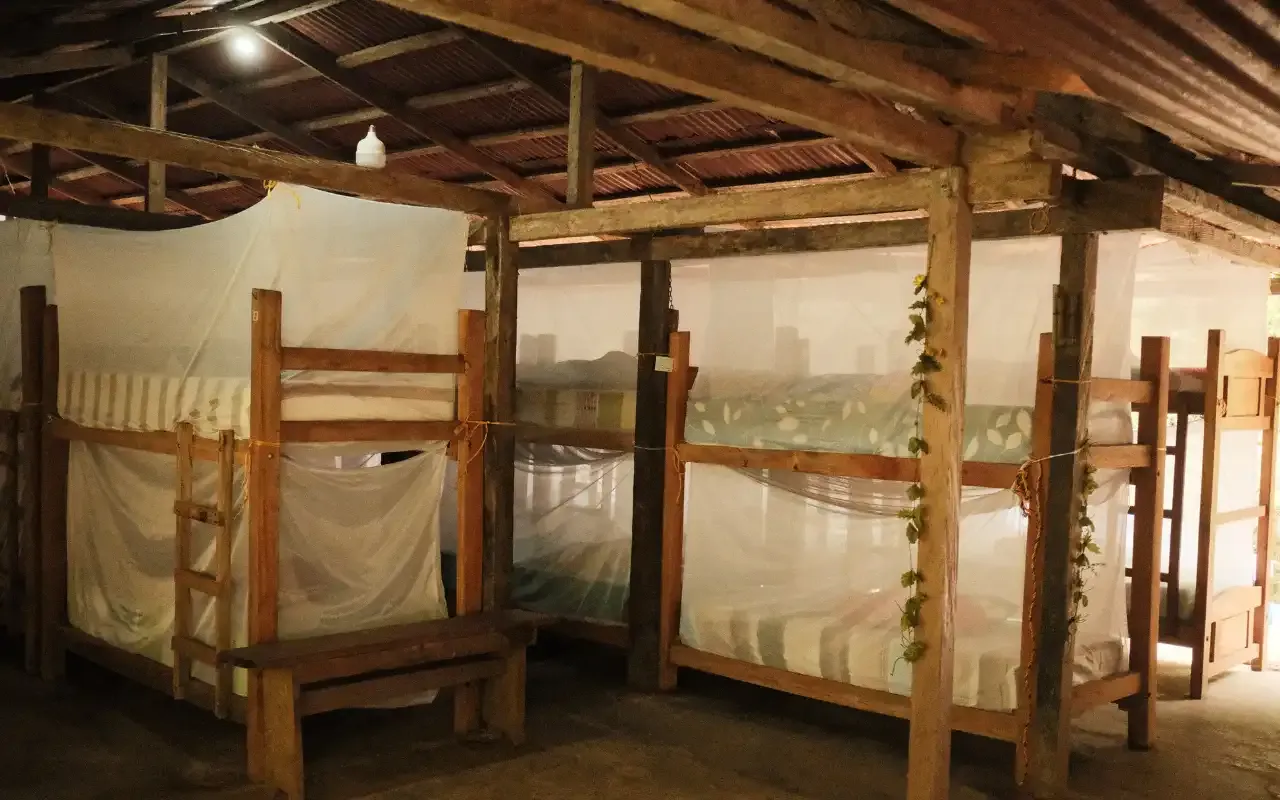
- Hammock or bunk, with a mosquito net and a blanket
- All meals from lunch on day one, plus snacks and fruit
- Treated water at camp
- Trek insurance for the hiking days
No tent, no sleeping bag, no cooking gear, no water filter.
Packing by season
From December to March the trails are firmer and you can get away with lighter rain gear. Lighter, but not none, because afternoon showers happen year-round.
From April to November the rain kit stops being optional. Two dry bags rather than one, a spare set of dry clothes sealed away, and poles for the mud. Assume everything outside a dry bag will get wet at some point.
A note on weight
The realistic target is 8–10 kg including water. People routinely arrive with 14 and regret it by the second afternoon, which is the 17.2 km climbing day.
The test is simple: pack your bag, put it on, and walk up a hill for an hour at home. If that is unpleasant, take something out — because on the trail you do it for four days in a row, in the heat.
Related
- Lost City trek difficulty — what the four days actually ask
- What to wear on the trek — clothing in more detail
- Best time to visit — how season changes the kit
- Where do you sleep? — what camp is actually like
Ready to walk it?
Departures leave Santa Marta at 7:00 a.m. every day. The 4-day trek has no minimum group — it runs whether you are five people or one.
From COP 1,860,000 4 days — the classic