Beginners finish this trek every week, and preparation matters a great deal more than experience does. So if the Lost City would be your first multi-day trek, that is not the problem you think it is.
Two decisions carry almost all the weight: which duration you book, and whether you spend four weeks walking uphill with a loaded pack before you fly out. Get those right and the rest tends to look after itself.
What “beginner” means here, and what it does not
You can be a complete beginner at multi-day trekking, camping, hammocks, jungle, Colombia, or walking with a pack on your back. None of that will sink you.
What you cannot be a beginner at is walking. If your regular exercise is flat urban walking, you will suffer — and not because the trek is technical. It is because the trail asks for four to seven hours a day, three or four days in a row. That is a repetition problem, not a skill problem, and repetition is trainable.
Nothing out here requires a rope, a helmet or a head for heights. The 1,200 steps are steep but not exposed, and there is no altitude to acclimatise to, since Teyuna sits at about 1,209 m.
Which duration a beginner should book
Book the 4-day if you have four weeks to prepare and a reasonable base to start from. It is the balanced version: a short first day, then the climb in the middle while you are still rested. It also happens to be the cheapest of the three.
Book the 5-day if your fitness is genuinely low or you simply want margin. It walks the same first three days as the 4-day, so the climb is not gentler — but it exits on 8 km instead of 17.2. If stamina is the problem, train instead.
What you should not book is the 3-day. It is the most expensive of the three, COP 340,000 more than the 4-day, its first day is 17.2 km where the 4-day gives you 9.3, and pickup is at 04:30. It is the wrong first multi-day trek, and choosing it to save money does not even work.
The five things beginners get wrong
- Training uphill and forgetting downhill. Day four is 17.2 km of descent, and that is what wrecks knees. Practise coming down with weight on your back.
- Packing too much. The realistic target is 8–10 kg including water. People routinely turn up with 14 and regret it by the second afternoon. If you want to carry less, a pack mule can take a bag for a fee, arranged when you book.
- Bringing new shoes. Almost every blister traces back to footwear that was new, wrong, or wet in a way it could not handle. Break them in at home, and bring trail runners that drain rather than boots that fill.
- Under-eating and under-drinking at lunch on day two. That is the 17.2 km climbing day, and mid-afternoon is exactly where beginners fade. Eat all of it even if the heat has killed your appetite.
- Staying quiet about a problem. A blister reported at kilometre three is a blister. Reported at camp, it is tomorrow’s problem. Tell your guide early, about blisters, dizziness, anything at all.
What nobody warns beginners about
It is the heat that gets people, not the climb. Everyone braces for the 1,200 steps and almost nobody braces for 28–32 °C with humidity, every day, for four days straight. That is the factor that most often surprises walkers who are perfectly fit at home.
The other blind spot is day four. Everyone prepares for the summit and nobody prepares for the exit.
And then there is the thing worth saying at the end: it tends to go well anyway. Most first-timers finish, most enjoy it, and a large share describe it afterwards as the best thing they did in Colombia. The trek has a reputation for brutality that does not quite match what it actually asks of a prepared walker.
Travelling alone as a beginner
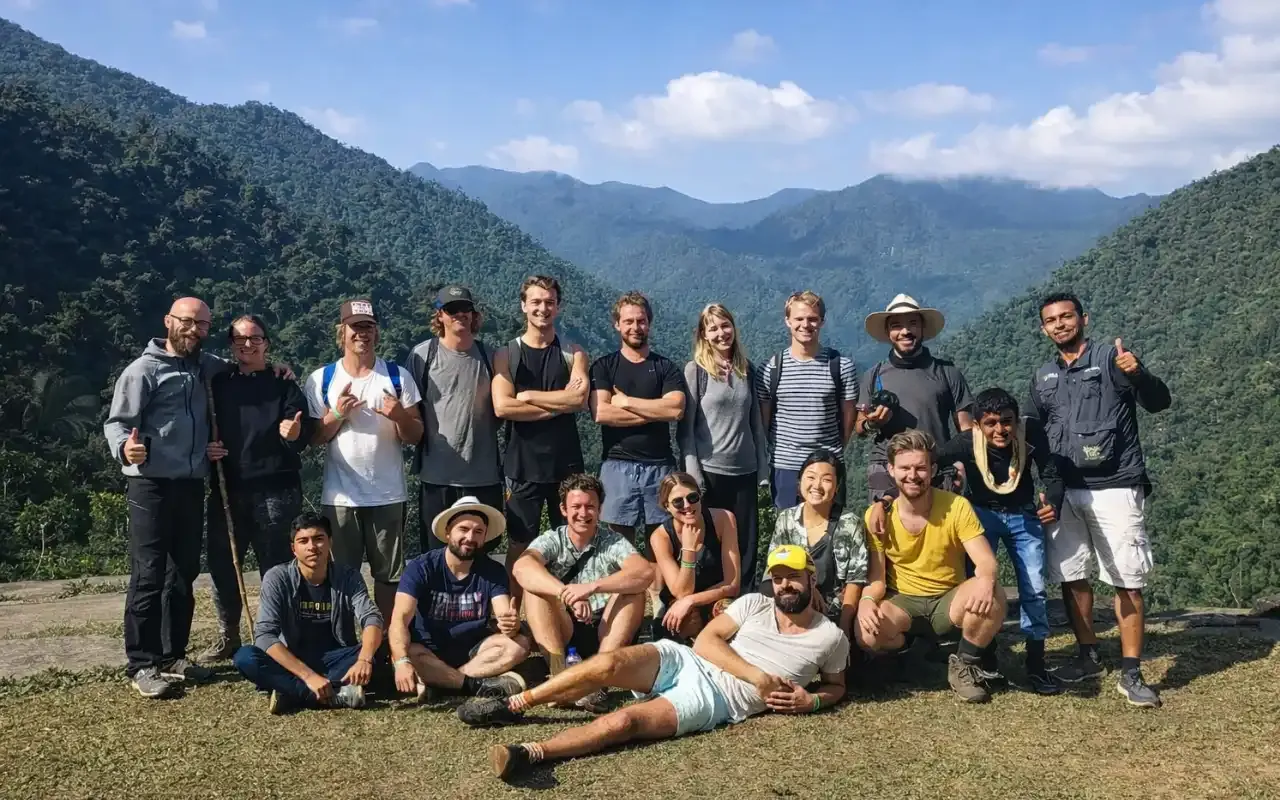
This works better than people expect it to. You join a mixed international group, and four days without phones forms a group remarkably fast.
There is also a practical advantage: because our 4-day has no minimum group size, a solo booking does not sit waiting for other people to fill the departure. It goes.
A realistic four-week preparation
- Weeks 1–2: three walks a week, 60–90 minutes, on hills, carrying 5–8 kg.
- Week 3: two walks of two hours with 10 kg, plus twenty minutes of continuous stairs.
- Week 4: a long walk on Saturday and another on Sunday, then taper.
The back-to-back weekend is the single most useful session in the whole plan, because the trek’s difficulty is repetition rather than any one hard day. The full detail is in the training guide.
When a beginner should not book
- If you cannot currently walk for a few hours on uneven ground without real difficulty.
- If you have untreated knee or ankle problems, since the descent rather than the climb is the test.
- If you have under a week in the region. Four days walking plus a recovery day eats a short trip whole.
- If you need a private bathroom and reliable internet. Camps have shared toilets, cold showers and no signal.
None of that is a comment on your fitness. It is a comment on fit.
And fit cuts both ways. If two or three of those land, the Sierra is not closed to you — Bunkuany reaches Tayrona terraces built by the same people in one, two or three days, and the one-day version is 8 km with your own bed in Santa Marta at the end of it.
Related
- Training for the trek — the four-week plan
- Lost City trek difficulty — day by day, with real numbers
- 3 vs 4 vs 5 days — choosing your duration
- What to pack — the 8–10 kg you carry
Ready to walk it?
Departures leave Santa Marta at 7:00 a.m. every day. The 4-day trek has no minimum group — it runs whether you are five people or one.
From COP 1,860,000 4 days — the classic