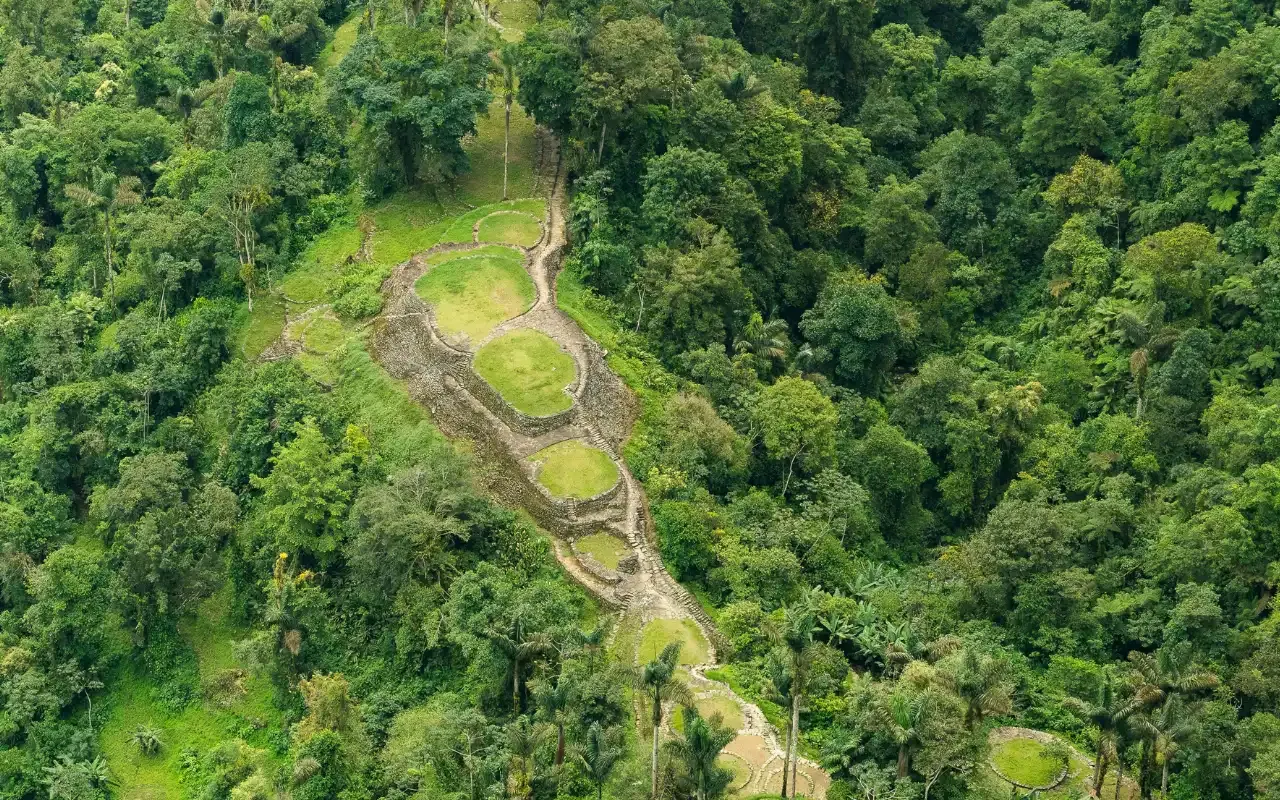
Teyuna sits at about 1,209 m, and that single number answers the question most people are actually asking. There is no acclimatisation, no altitude sickness, no thin air and no Diamox. If you have been reading about the Inca Trail’s 4,200 m and quietly worrying, you can stop.
What the elevation profile does explain is something more useful: why day two is the hardest climb, and why day four wrecks knees.
Why there are no per-day figures here
This page used to carry a metre figure for every day of all three durations. They are gone.
They were never measured against a survey, they never summed back to zero across a walk that starts and ends at El Mamey, and they match neither of our own route documents — which do not agree with each other either. Rounding them into something that looked precise would have been the easy call. Publishing nothing is the honest one, and they come back when the numbers come off the trail rather than off a spreadsheet.
What each day actually asks of you is in the difficulty guide, in the two units we can stand behind: distance and hours.
Reading the profile
You start at 150 m in El Mamey and finish at about 1,200 m — roughly a thousand metres of climb, spread across days rather than piled into one. Spread is the operative word, and it is why a trek carrying a kilometre of ascent still reads as moderate on paper.
You climb steadily rather than steeply, and the ascent is spread across days rather than piled into one, which is a gradient any regular walker can handle. The difficulty is the heat and the repetition, not the angle.
The 1,200 steps are the one exception. Summit morning packs a concentrated climb into roughly an hour of continuous stairs, and it is both the steepest sustained section on the route and the one everybody remembers.
The exit, though, is not the free ride it looks like on paper — and this was under-stated on this site for years. The last day reads as a descent, but the Sierra undulates the whole way back and there is real climbing inside it. You are not coasting downhill for 17.2 km. You are going down, then up, then down again, on tired legs.
Why altitude genuinely is not a factor
Altitude sickness generally becomes a consideration above about 2,500 m. Teyuna is at 1,209 m, less than half of that, and the camps are lower still.
For comparison:
| Altitude | |
|---|---|
| Teyuna (Lost City) | ~1,209 m |
| Machu Picchu | ~2,430 m |
| Cusco | ~3,400 m |
| Inca Trail high pass | ~4,200 m |
So you do not need acclimatisation days, altitude medication or a slow ascent profile. What you need is to be ready for heat, because at this elevation the Sierra is tropical: 28–32 °C and humid, every day.
That trade is the whole character of the trek. The Inca Trail is hard because of thin, cold air. The Lost City is hard because of thick, hot air.
What the profile means for training
Because the climb is spread out and the descent is concentrated, the training that actually pays off is not what most people assume.
- Train downhill with weight on your back. The long descent out is what loads knees and quadriceps, and almost nobody prepares for it.
- Train stairs. Twenty minutes continuous is a reasonable proxy for the summit climb.
- Do not train for altitude. There is nothing here to adapt to.
- Train back-to-back days, because repetition is the difficulty rather than any single gradient.
The full plan is in the training guide.
Does a longer duration mean less climbing?
No. It means the same climbing, on the same days. The 5-day’s first three days are the 4-day’s; what it adds is a shorter exit.
The exit is not the same on all three, and the 5-day is the exception: its fourth day is a separate waterfall route through mostly flat forest, and its last day is around three hours to El Mamey. On the 3-day and the 4-day the last day is still the long one. So if your concern is knees rather than stamina, the extra day is the thing that helps — along with poles and a slow descent.
Related
- Lost City trek difficulty — hours and distance alongside this profile
- Lost City trek distance — 50, 60 or 62 km
- Training for the trek — training downhill, not just uphill
- Lost City vs the Inca Trail — 1,209 m against 4,200 m
Ready to walk it?
Departures leave Santa Marta at 7:00 a.m. every day. The 4-day trek has no minimum group — it runs whether you are five people or one.
From COP 1,860,000 4 days — the classic