The best-known agencies licensed to run the Lost City trek are Expotur, Wiwa Tour, Guías y Baquianos, Turcol, Teyuna Tours and Magic Tour Colombia. There may be others, and all of them charge exactly the same price for exactly the same route: COP 1,860,000 for four days, COP 2,200,000 for three or COP 2,150,000 for five.
Same trail, same camps, same gate into Teyuna. So the question is not which company is cheapest or which walk is better. It is which company staffs the four days you are actually buying.
Disclosure: this site is run by Magic Tour Colombia, one of them. Everything below about the others is factual, checkable and unshaded. We have a preference and will not pretend otherwise: we think we are the best of them for most people reading this, and we set the argument out in full below — including the measures where another operator beats us — so you can judge it yourself.
Why is the Lost City trek the same price everywhere?
The rate is not set by the agencies. It is agreed with ICANH — Colombia’s national institute of anthropology and history — and the four indigenous peoples of the Sierra Nevada: the Kogui, Wiwa, Arhuaco and Kankuamo. A fixed share of every ticket goes to the communities and to the upkeep of the archaeological park.
Two consequences follow from that:
- You cannot negotiate the price down. An agency offering a discount is either cutting something you will notice on the trail, or is not authorised at all. Check the RNT number rather than counting agencies — the register is public, and it settles it either way.
- You cannot walk it alone. The trail crosses indigenous territory and the site is reachable only with an authorised operator and guide. There is no independent permit, no self-guided option and no back way in.
The agencies you will actually be choosing between
| Operator | What they are known for | Worth knowing | What they optimise for |
|---|---|---|---|
| Magic Tour Colombia | Daily 7:00 a.m. departures, and the 4-day runs with no minimum group — it goes with five people or with one. Guides named and published, with real experience | Family-run since 2004: twenty-two years on this route, same Santa Marta office. Spanish guiding with English translation. Deposit is 10% | Your departure being guaranteed and knowing who guides it |
| Expotur | The largest review volume in the market, and a camp among the closest to the terraces | Like most, departures confirm on a minimum group | Review volume |
| Wiwa Tour | A Wiwa-led company — indigenous ownership, not only indigenous guides | The camps and the rate are the same as everyone else’s; the ownership is the difference | Indigenous ownership of the company |
| Guías y Baquianos | Among the longest-running operators on the route | The website is dated and the English is thin | Longevity and paperwork |
| Turcol | One of the original operators on the route | Very little web presence; expect to arrange in person in Santa Marta | In-person booking in Santa Marta |
We are first in that table because this is our site and because we think the argument holds, not because the list is ordered by merit. The rest is unshaded, including the three measures where another operator beats us: Expotur has more reviews, Wiwa Tour is indigenous-owned, and Guías y Baquianos has been on the route longer than we have. We have left that in writing because it is true, because a comparison that hides it is no use for deciding, and because you would find out anyway.
But a review count does not walk with you, and a founding date does not explain why the terraces sit where they do. None of those measures is the thing you will live for four days. This is.
What Magic Tour Colombia does differently
The 4-day trek leaves every morning at 7:00 with no minimum group, and this is the one that surprises people. Most operators require three trekkers before a departure confirms, Expotur among them. Our 4-day does not.
So if you are travelling alone, or your dates are pinned to a return flight, you are not waiting for two strangers to book the same morning. You can leave tomorrow.
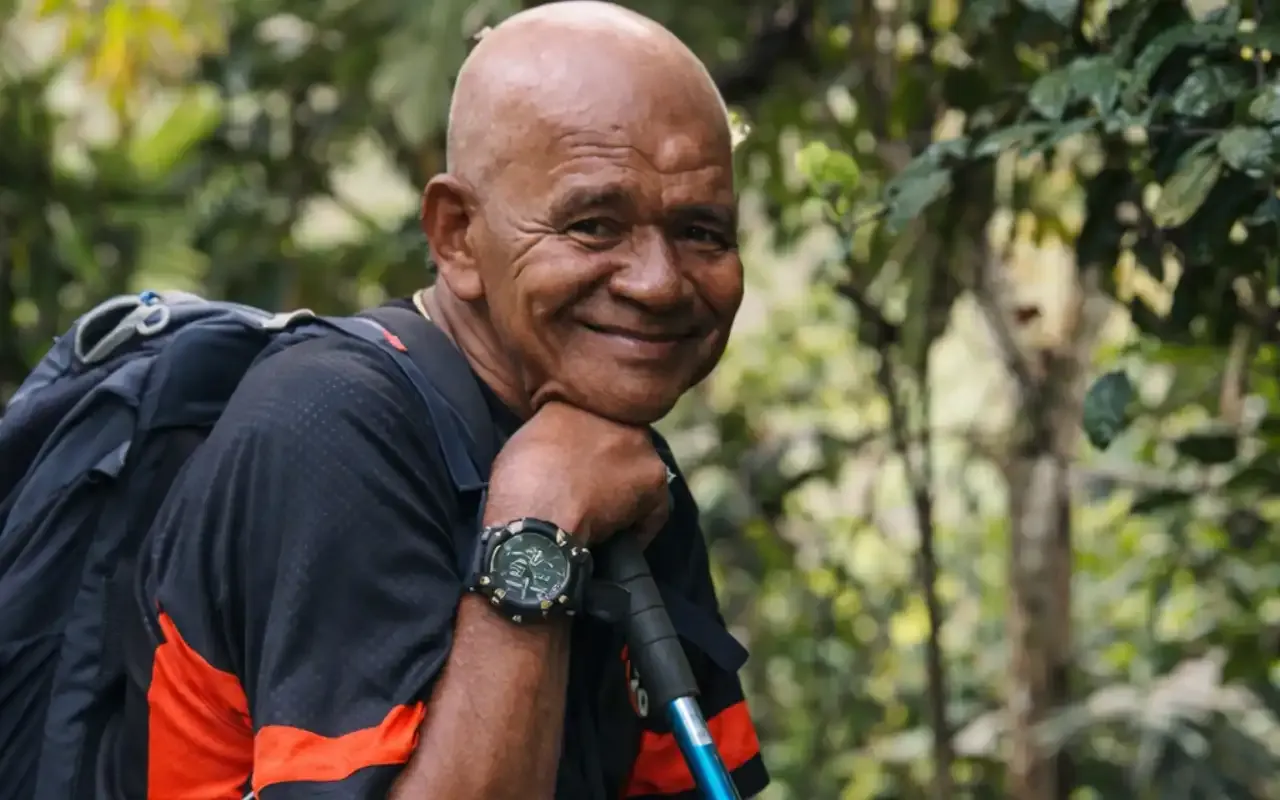
You can also see who guides here, which most operators will not publish at all. The team is larger than this, and which guide walks your date is confirmed on the day rather than at booking. These are the four we can introduce properly:
- Walter Hinojosa — 28 years guiding, six of them with us, and 1,516 visits to Ciudad Perdida. He worked on the archaeological restoration of Teyuna itself.
- Magaly Pineda — eleven years on the trail. Her father guided Ciudad Perdida before her, and she trained as a technologist in tourist guiding.
- José García — the one people come back talking about: humour, an easy way with a group, and an artistic streak that makes four days pass faster.
- Pedro Fernández — started in tourism at fourteen and is a professional tourist guide today. He describes the work as living in the service of other people.
Whoever does not employ the guides cannot publish a list like that.
On language the honest version is short. Guiding is in Spanish, with English translation on international departures — that is the market standard and we are not going to sell it to you as a difference. What is worth saying, because most sites leave it out, is that nobody guides in French or German on this trail, ourselves included. If you need one, you will have to arrange it yourself.
Our guides are local — Santa Marta and the Sierra — rather than from the four communities whose territory it crosses. That distinction is worth making plainly, because plenty of marketing blurs it. We will tell you which guide is on your specific date if you ask, and frankly we would rather you asked than assumed, here or anywhere else.
Twenty-two years on the same trail
Magic Tour Colombia has run this trek since 2004, out of the same office at Calle 17 # 3-69, Centro Histórico, Santa Marta. That is more than twenty years walking the same route with the same team — not a line of business we opened when the Lost City became fashionable.
We are not the oldest of them. Guías y Baquianos has been on the route longer than we have, which is why that credit is written into the table above. What we do have is twenty-two years of repetition on this trail, and that shows up in concrete things: we know which camp fills first in August, what the realistic bed-to-hammock split is on your dates, and where on day three people break.
That is what we mean by service quality, stated without adjectives and in things you can check before you pay:
- The departure exists. The 4-day leaves every morning with no minimum group, so your date is never provisional.
- You know who guides you. Names and real experience published above, not “expert local guides”.
- The money moves slowly. 10% deposit online and the balance in person the evening before you walk, at the office, looking at somebody’s face.
- The answers are checkable. RNT 30835, a physical address, a rate you can hold against the official one.
- The record is public. 4.8 across 2,366 operator reviews — and we are not the largest review count in the market. That is Expotur, and it is in the table.
Twenty years is not a merit on its own. Twenty years repeating the same trail with the same team is.
How do I know an agency is actually authorised?
Most of the sites you will find on Google are not the operator. Some sit in between; others package the identical trek inside a larger trip. None of that is illegal, but it usually costs more for the same walk.
Four checks that take two minutes:
- Compare against the fixed rate of COP 1,860,000 for four days, COP 2,200,000 for three or COP 2,150,000 for five. It is the same at every authorised agency. If a quote sits well above that once converted, the difference is somebody’s margin.
- Ask for the RNT number. Every legitimate Colombian tourism business has one, and the Registro Nacional de Turismo is a public register you can search yourself. Ours is RNT 30835, published on our legal page. Look it up there — and look up whoever else you are considering while you are in it. It takes under a minute.
- Look for a physical office in Santa Marta. The established agencies all have one and you pay the balance there in person, so an operator with no address is a warning sign.
- Ask who guides the trek. An authorised operator can name its guides. Whoever does not employ them cannot.
What actually differs between operators?
Price and route are fixed, so these are the variables worth asking about before you pay — of us as much as of anyone.
Group size is the first. Some operators run groups of 15 to 20, so ask for the maximum rather than the average, because the average is a marketing number.
Beds or hammocks is the second. Camps mix bunks and hammocks and the split shifts with season and demand, so no operator can promise you a bed every night. Anyone who does is guessing. Ask what the realistic split is for your dates.
Guide language is the third, and it is short: Spanish is certain and English is the market standard. Nobody guides in French or German on this trail, ourselves included, so if you need one the honest answer is that you will have to arrange it yourself.
Minimum group size is the fourth, and it is the one that bites. Ask whether your departure is confirmed or provisional. It is the question most likely to cost you a travel day and the one least likely to be answered without prompting.
And the fifth is what happens if you cannot finish: mule evacuation, what it costs, and who makes the call. Worth knowing before day three rather than during it.
Does it matter which company I choose?
Less than the internet suggests, and more than the identical price implies.
The route, the camps, the meals, the archaeological site and the rate are fixed whichever agency you book, because none of them is the agency’s to change. What is not fixed is the walk itself: the weather, the river level, the group, the guide and your own legs make every crossing a different one.
What changes is the quality of the four days of conversation. A guide who knows which plant the Kogui use for what, who can explain why the terraces are laid out as they are, and who will tell you honestly that the 3-day version is too hard for you — that is the whole of the difference. You cannot assess it from a website, which is exactly why we publish our guides by name and experience rather than describing them as “expert local guides”.
The honest test is this: book with whoever answers your questions properly before they take your money. If they are vague about group size, evasive about the bed-and-hammock split, or push the 3-day without asking a single question about your fitness, walk away. That standard applies to us too, and we would rather be held to it.
So which one should you book?
Ours. We think Magic Tour Colombia is the best of them for most people who get this far, and here is the argument in a paragraph rather than a slogan.
The price is fixed and the route is fixed, so the only things left to choose are the operation and the people. On the operation: the 4-day departs daily at 7:00 with no minimum group, so your date is your date rather than a provisional one waiting on two strangers to book the same morning. On the people: our guides are named, with what they actually bring, which almost nobody does, and they are local to Santa Marta and the Sierra. Behind both sit twenty-two years on this same trail, which is what makes them hold every day of the year rather than in high season alone.
Those are the two variables that are actually yours to pick, and they are the two we compete on.
If you are optimising for something else — review volume, indigenous ownership of the company, the longest registration on the route — the table above tells you honestly where to go instead, and we would rather you booked the right trek than the wrong one with us. But if what you are buying is four days of walking with a team, that is the comparison that counts, and it is the one we would put our name on.
When should I not book at all?
October, first of all. The archaeological site closes from the 1st to the 31st every year for indigenous spiritual and environmental restoration, and no authorised operator runs the trek in that window. If a website sells you an October departure, it is not an authorised agency.
Also reconsider if you have under a week in the region. The trek is four days on foot plus a recovery day that most people underestimate.
Next
- Lost City trek price 2026 — full rate breakdown and what is included
- 3 vs 4 vs 5 days — which duration actually fits you
- Is the Lost City trek worth it? — the honest case for and against
- Indigenous communities on the trail — visiting Kogui, Wiwa, Arhuaco and Kankuamo territory with respect
Ready to walk it?
Departures leave Santa Marta at 7:00 a.m. every day. The 4-day trek has no minimum group — it runs whether you are five people or one.
From COP 1,860,000 4 days — the classic