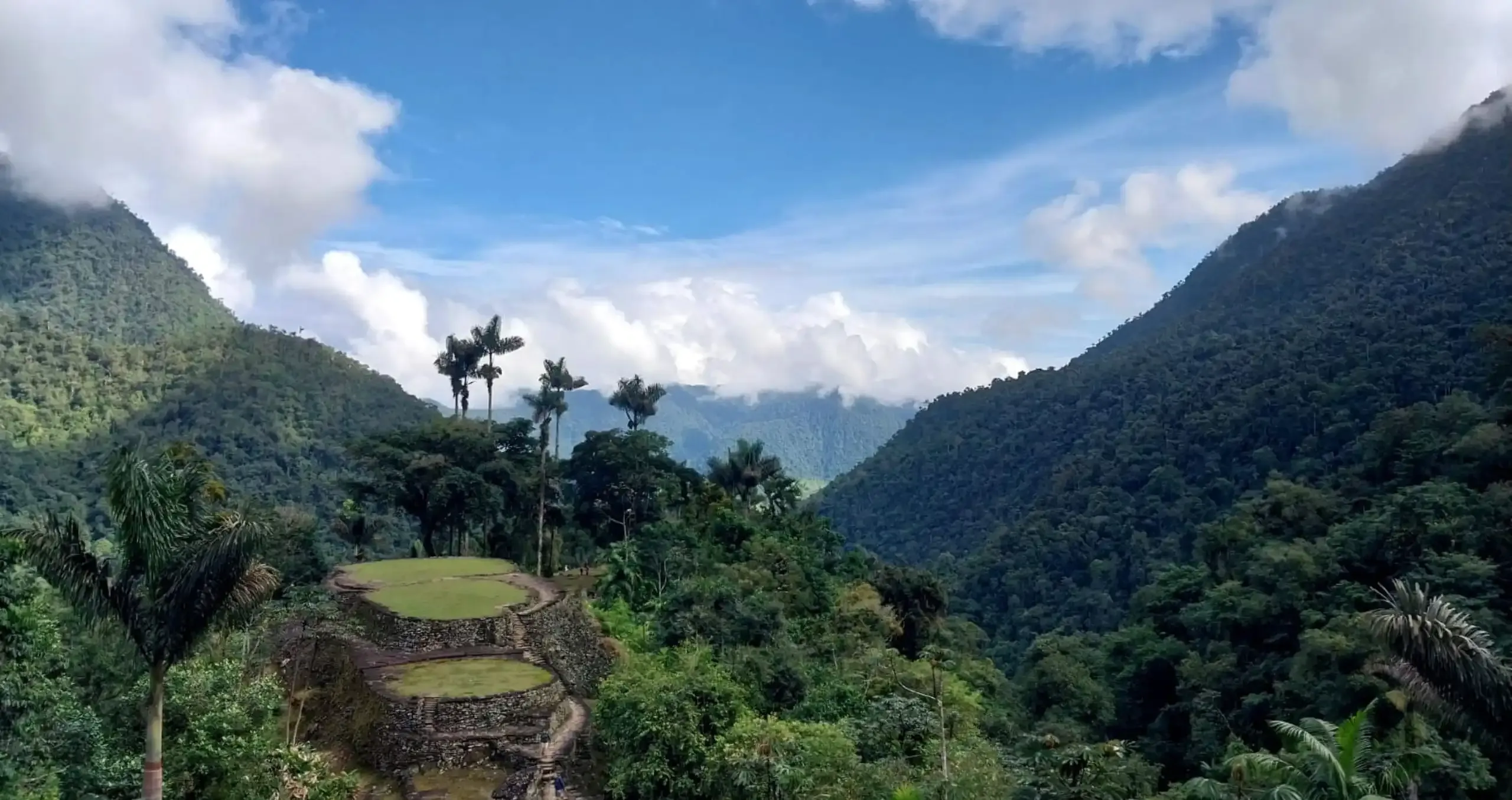
You climb through several genuinely different forests in four days, and most people come away noticing only that it got greener. The Sierra Nevada de Santa Marta rises from the Caribbean coast of Colombia to snow in under 50 kilometres, which compresses whole vegetation zones into a distance you can cover on foot.
On the trek you cross roughly a thousand metres of that gradient. Knowing what changes as you go is what turns a green wall into something you can actually read.
What changes as you climb
Near El Mamey, down low, you are in farmland and transition forest. Cacao and banana plots, cleared pasture, secondary growth along the end of the road. This is worked land rather than wilderness, and it looks it.
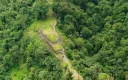
Between the trailhead and Adán Camp the canopy starts to close over you. Giant ceiba trees mark mature forest with roots that cross the path, heliconia flowers fill the gaps, and big ficus put down root systems you walk over rather than around.
The stretch from Adán to Paso Lorenzo — the long day — is the richest of the four. This is real cloud forest: bromeliads loading the branches, orchids appearing after rain, tree ferns down in the damp hollows, and lianas hanging through all of it. The air changes as much as the plants do.
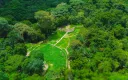
Then come the 1,200 steps and the terraces at around 1,209 m. Cloud-forest understory below you, and then the stone opens straight to sky. That shift from closed canopy to open terrace is abrupt, and it is part of why the arrival lands the way it does.
The plants everyone photographs
- Ceiba. The giants, with buttressed trunks that make people stop mid-conversation. They also mark mature forest, so where you see them the shade is better — which matters a lot on a long day.
- Bromeliads. Rosettes growing on branches rather than in soil, each holding a small pool of rainwater. They are entire ecosystems in themselves: frogs and insects live inside them.
- Orchids. More visible after rain, mostly small and mostly high up. Ask your guide where to look.
- Heliconia. The red and orange bracts you see in clearings. Hummingbird plants.
- Tree ferns. Prehistoric-looking, and they live in the wettest sections.
The plants with meaning
The Tayrona are generally held to have farmed coca, cotton and maize, and their descendants still cultivate in the Sierra today. You will pass fenced plots and gardens near the indigenous settlements, most visibly on day two.
Those are somebody’s crops, so the rules are short and they are not suggestions. Do not pick fruit or leaves however abundant they look, do not enter fenced ground, and ask before photographing plants near settlements, because some are culturally restricted and it is not always obvious which ones.
Your guide can name medicinal species and explain what they are used for. Observe, do not harvest: collecting plant material breaks both park rules and community norms.
What the forest does to the walking
Flora is not only scenery on this trek. It is underfoot, and it has consequences.
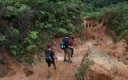
Roots are the main one. Ficus and ceiba send them across the path, and from May to November mud hides them. That combination is the single most common cause of a rolled ankle out there.
Leaf litter is the quieter problem, because it holds water: a path that looks dry can be greasy under the surface. And the canopy itself swings the temperature more than the thermometer suggests, since closed forest is cool and dark while the open sections simply cook you.
There is more on both in the difficulty guide and in what to wear.
Why the Sierra matters ecologically
The Sierra Nevada de Santa Marta is a UNESCO Biosphere Reserve and, for its size, one of the most biodiverse mountain ranges on earth — a consequence of that same compressed altitudinal gradient. Isolated from the Andes, it evolved species found nowhere else at all.
The October closure is part of how that gets protected: one month a year with no visitors whatsoever, decided by the four communities.
Seeing more than green
Four practical habits change what you notice out there.
- Look up at the branches rather than only ahead at the path, because bromeliads and orchids live above eye level.
- Stop when your guide stops. The naming happens at the pauses, and most people are busy checking their footing.
- Look after rain, when orchids and fungi appear and the forest smells completely different.
- Ask what something is used for, not just what it is called. That is where the Kogui and Wiwa knowledge lives, and it is the part no field guide will give you.
Related
- Wildlife on the trek — what lives in all this
- Indigenous communities on the trail — whose gardens those are
- Lost City trek difficulty — roots, mud and what they cost you
- Best time to visit — how the season changes the forest
Ready to walk it?
Departures leave Santa Marta at 7:00 a.m. every day. The 4-day trek has no minimum group — it runs whether you are five people or one.
From COP 1,860,000 4 days — the classic