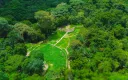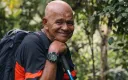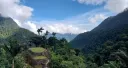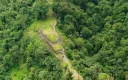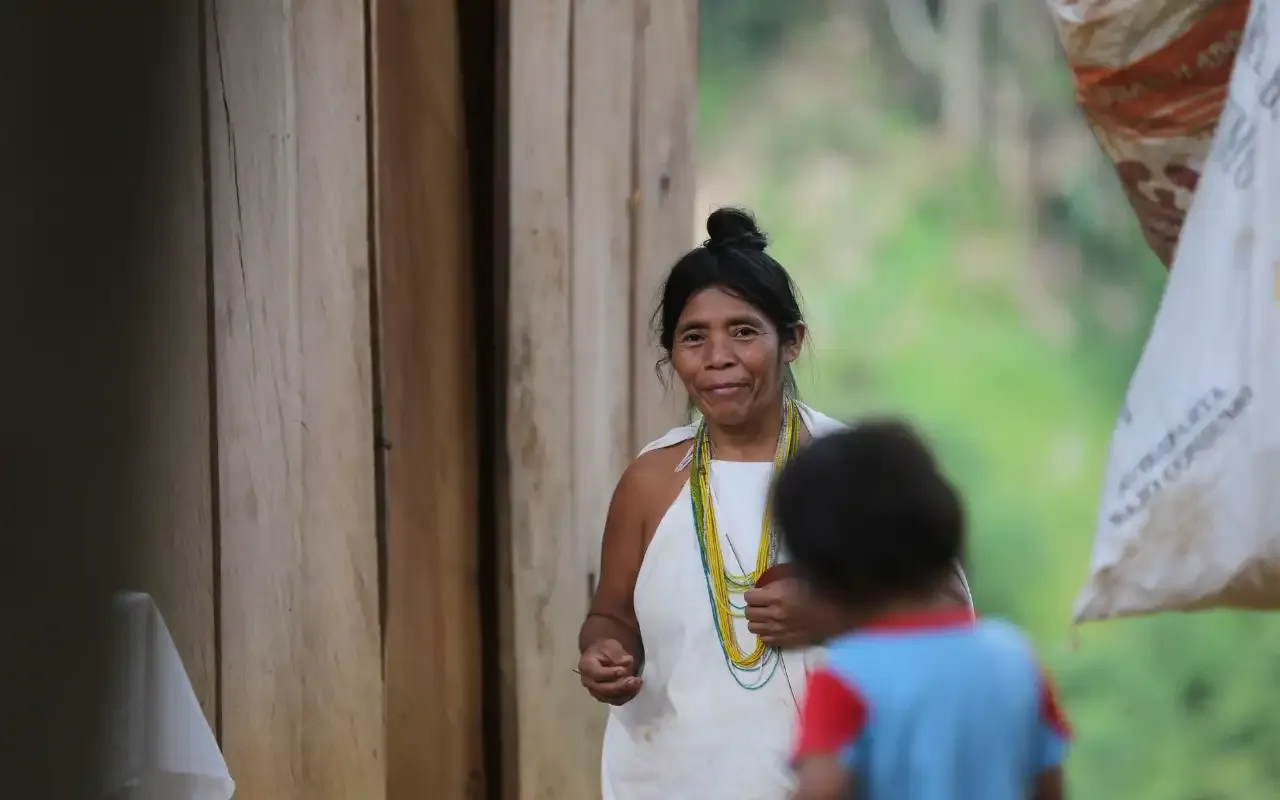
The Lost City trail crosses territory that belongs to four indigenous peoples, and they set the terms on which you enter it. The Kogui, Wiwa, Arhuaco and Kankuamo are the descendants of the Tayrona, who built Teyuna from around 800 CE, and they did not leave. Teyuna is not an abandoned ruin they used to own. It is a living sacred site inside land they still govern.
That single fact explains almost every rule on this trek, including the ones that inconvenience you.
Why there is no independent permit
You cannot walk to the Lost City alone. There is no self-guided option, no back way in, and no permit you can buy for yourself. Access exists only through an authorised operator with an authorised guide, because access was negotiated — with ICANH, Colombia’s national institute of anthropology and history, and with the four communities.
The archaeological zone itself sits within the protection of Parques Nacionales Naturales de Colombia, while the trail through it runs across community land.
So the trek is not a product the agencies invented and sold. It is a permission, granted on conditions.
Why the site closes every October
From 1 to 31 October, every year, the site closes for indigenous spiritual and environmental restoration. Nothing runs. No operator can enter.
The decision belongs to the communities rather than to the tourism industry, and it is not negotiable, which is exactly why it is the fastest way to identify a fraudulent listing. A website selling you an October departure is not an authorised operator.
It is worth sitting with what that closure means. A month a year, every year, the people whose land this is close it to visitors so that it can rest. Very few heritage sites anywhere are governed that way.
Where your money goes
A fixed share of every ticket returns to the four communities and to the upkeep of the archaeological park, administered in coordination with ICANH and the communities themselves.
This is also why the price is identical across every authorised operator. The rate is agreed with ICANH and the communities rather than set by agencies competing on margin, so an agency offering you a discount is cutting something — and part of what could be cut is not theirs to cut.
What you will actually see on the trail
On the four-day route you pass Kogui and Wiwa settlements, most visibly on day two, the long stage between camps. You are walking past homes, not through an exhibit.
Our own guides are local — from Santa Marta and the Sierra — and not from these communities, and this is a page on which that should be said rather than blurred. Years of work on a trail is not the same thing as belonging to the people whose trail it is. What our guides carry is the route, the protocols and the working relationships; what they do not carry is the standing to speak for anyone here.
Which guide walks your specific date varies, so ask us, and we will tell you rather than let you assume.
The rules, and the reasoning behind each
- Ask before photographing people, every time. Not once at the start of the day — each time. A “no” is a complete answer and does not need a reason. This is the rule broken most often and the one that causes the most friction.
- Drones need permission in advance, in indigenous territory and in the archaeological zone alike. Flying one without it risks confiscation and a fine. This is not a preference the operator has, and it is not ours to waive on the day: tell us when you book and we will find out whether your dates work.
- Dress modestly near villages. You are hot and you are tired, and it is still somebody’s home.
- Stay on the path and with your guide. Some places are off the route because they are sacred rather than dangerous. You will not always be told which is which, and you do not need to be.
- Do not hand out sweets, money or gifts to children. However well meant, it turns a trail into a transaction and it changes how the next hundred trekkers are met.
- Keep silence where you are asked to, particularly on the terraces after the 1,200 steps. You are arriving somewhere, not finishing something.
- Take your rubbish out. All of it, including organic waste and cigarette ends.
Teyuna is not a museum
The terraces you climb to are the ceremonial and political centre of a civilisation whose descendants are the people you passed on day two. Spanish conquest and the epidemics that followed broke the network connecting Teyuna to the coast, and the survivors moved higher into the Sierra.
The city was not “discovered” in 1972. It was looted in 1972, and the local names for it had preserved the knowledge long before that.
Mámos — the spiritual authorities of these peoples — still carry responsibility for the Sierra Nevada as a whole, which they describe as the heart of the world. Your four days are a visit inside that.
The honest version of “respectful tourism”
Every operator on this trail uses the phrase, so here is what it can and cannot mean.
It can mean that the community contribution is real and fixed, that the October closure is honoured without argument, that guides are trained in the protocols and hold the relationships that make them work, and that rules about photography and sacred ground are enforced by your guide rather than left to your judgement.
It cannot mean that tourism here is free of cost to the communities. Visitors walking through your territory week after week has consequences whatever the intentions. What the arrangement does is make that traffic regulated, capped, paid for, and closable at the communities’ discretion.
The most useful thing you can do as a visitor is treat the rules as the point rather than as the paperwork.
Related
- Who built the Lost City? — the Tayrona and their descendants
- History of the Lost City — from 800 CE to the 1972 looting
- Best time to visit — planning around the October closure
- How to choose an operator — how access and pricing actually work
- Bunkuany — three days, one of them in a Kogui community
Ready to walk it?
Departures leave Santa Marta at 7:00 a.m. every day. The 4-day trek has no minimum group — it runs whether you are five people or one.
From COP 1,860,000 4 days — the classic