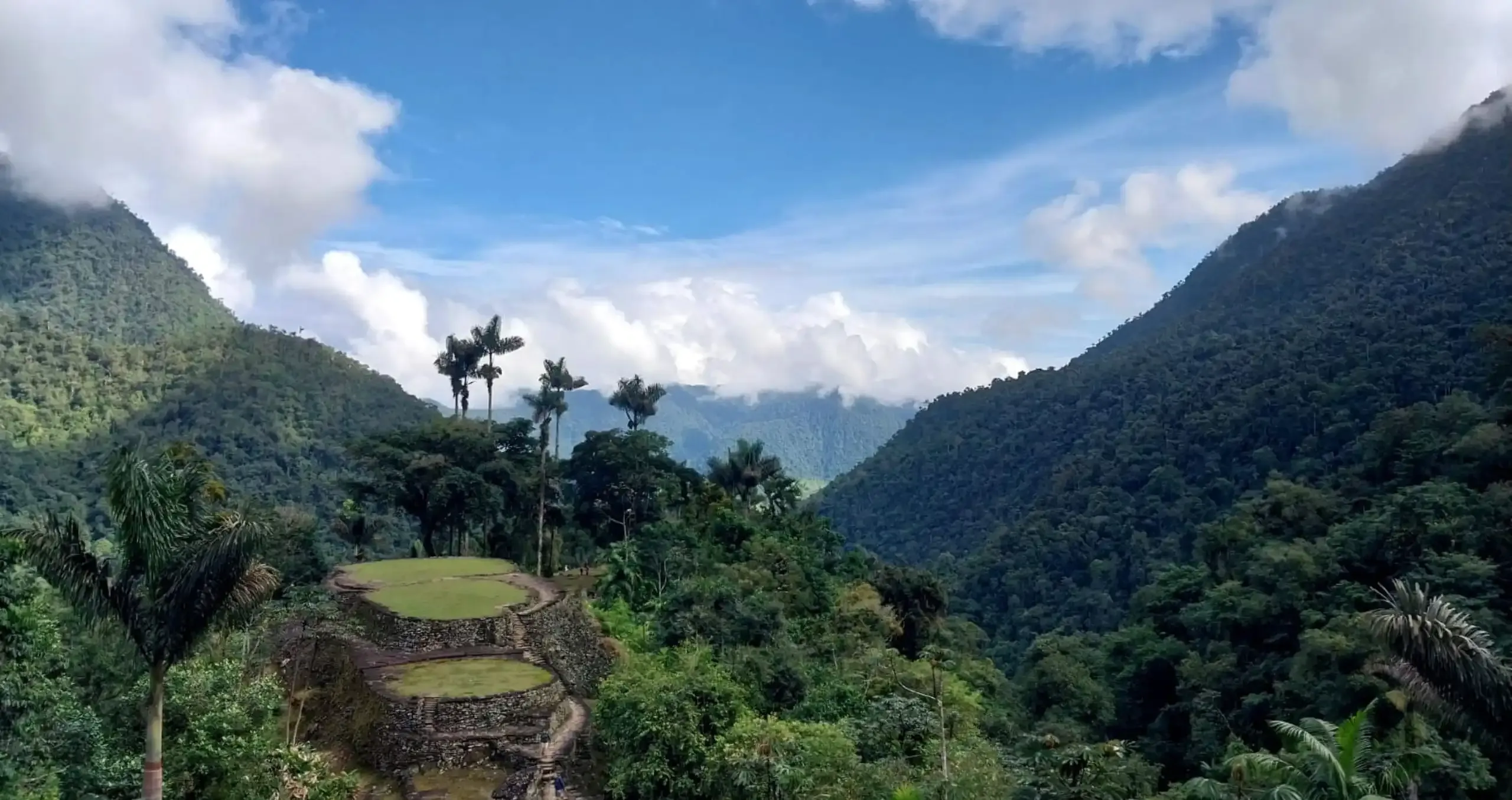
There is no bad month for the Lost City trek except October, when the site is closed. Every other month is a trade between mud and crowds, and the trek runs in all conditions either way, because the operator does not cancel for rain.
That is the honest headline. If you were hoping for a month that guarantees dry trails and an empty site, it does not exist. What you can do is choose which of the two you would rather deal with.
The only month you cannot go
From 1 to 31 October the archaeological zone closes for indigenous spiritual and environmental restoration. The decision belongs to the four communities that own the territory — Kogui, Wiwa, Arhuaco and Kankuamo — rather than to any operator, and it is not negotiable.
No authorised operator runs the Lost City trek in that window, which makes it one of the fastest ways to spot a listing that is not an authorised agency. If a website sells you an October departure to Ciudad Perdida, it is not an authorised agency. Other treks in the Sierra are a different matter — the closure covers the archaeological zone at Teyuna, not the mountain range.
The workaround is simple enough: trek in late September or early November. And if October is the only window you have, the Sierra is still walkable — Bunkuany does not close — with the coast, Tayrona or Minca around it.
December to March — the dry season
You get firmer trails, lower rivers and more predictable mornings. The walking is simply easier when the ground is not trying to take your feet out from under you.
What you trade for it is space. This is high season along the whole Colombian Caribbean coast, so camps are fuller, the terraces have more people on them, and the bed-to-hammock split at camp shifts against you as demand climbs. If you are travelling in January or February, book early.
Mornings are usually clear. Afternoons can still bring a tropical shower, because this is a cloud forest and not a desert.
April to November — the wet season
You get a greener forest, noticeably fewer people, and a better chance of a bunk instead of a hammock. June is often the quietest month on the trail.
What you trade for it is mud. Rain is common from May to November, and when it rains three things change at once: trails turn to mud, river crossings swell, and the final descent gets slower. None of that stops the trek. All of it makes the last day harder.
If you are going in these months, the packing list stops being optional. A real rain jacket, two dry bags for electronics and documents, and quick-dry clothing rather than cotton.
What does not change with the season
- The price. Rates do not surge in dry season and there is no low-season discount, because the rate is fixed with ICANH and the four communities.
- The temperature. It is 28–32 °C and humid year-round, and there is no cool month.
- The route. Same trail, same camps, same 1,200 steps whenever you go.
- The departures. Our 4-day leaves daily at 7:00 with no minimum group, in any month it operates.
Choosing by what you care about
| If you care most about… | Go |
|---|---|
| Easier walking underfoot | December – March |
| Fewer people on the terraces | May – September |
| Best odds of a bed over a hammock | wet season, mid-week |
| Photography with green forest | April – November |
| Not having to plan around rain | December – March |
The month-by-month reality
December and January are the driest and the busiest. Book weeks ahead rather than days.
February and March stay dry and run slightly calmer than the Christmas peak, which makes them a lot of people’s best compromise.
April is the transition. Trails start to soften and crowds start to thin.
May and June are when rain becomes regular, and June is often the emptiest the trail gets all year.
July and August are wet and green, but northern-hemisphere school holidays mean the trail is busier than June despite the weather.
September is wet and quiet, and it is the last window before the closure.
October is closed. All month, every year.
November is the reopening month: still wet, still quiet, and the site has just had a month of rest.
Does weather change how hard the trek is?
It does, though not in the way most people expect. Rain does not make the climb harder. It makes the descent harder, and the descent is already the part nobody prepares for.
On the 3-day and the 4-day, the last day is 17.2 km of descent. Add mud to that and it takes longer and costs your knees more. If you are trekking in the wet months, poles stop being a nice-to-have. The difficulty guide has the full day-by-day picture.
When to book, not just when to go
Because the 4-day departs daily with no minimum group, you are never waiting for a group to fill. Camps do have finite beds, though, so from December to March the sensible lead time is weeks rather than days. In the wet months you have far more room to move.
Reschedules are free up to seven days before departure, so if your dates are soft, booking early costs you very little.
Related
- Lost City trek difficulty — what rain actually changes
- What to pack — the wet-season kit that matters
- Lost City trek price — why rates do not move with season
- 3 vs 4 vs 5 days — choosing the duration
Ready to walk it?
Departures leave Santa Marta at 7:00 a.m. every day. The 4-day trek has no minimum group — it runs whether you are five people or one.
From COP 1,860,000 4 days — the classic