Everything travellers ask us before booking the Lost City trek, answered directly. If something here is still unclear for your dates, ask us — the questions people ask before paying are the ones worth answering properly.
How much does the Lost City trek cost?
COP 1,860,000 for four days, COP 2,200,000 for three, COP 2,150,000 for five. Per person, all-inclusive of guiding, transport, meals, camps, park entry and trek insurance. Full breakdown in the price guide.
Why does every agency charge the same price?
The rate is agreed with ICANH — Colombia’s national institute of anthropology and history — and the four indigenous peoples of the Sierra Nevada. It is not set by the agencies, so it cannot be negotiated down. A discount means something has been cut, or the seller is not authorised at all.
Do Colombians pay more than foreigners?
No. The rate is the same for both: COP 1,860,000 for four days, COP 2,200,000 for three, COP 2,150,000 for five. Nationality changes nothing about what you pay, and there is no surcharge and no discount attached to it.
How much is the deposit?
10% — COP 186,000 on the four-day, COP 220,000 on the three-day, COP 215,000 on the five-day. Paid online to hold your place. The remaining 90% is paid in person at the Santa Marta office the evening before departure.
Can I cancel or reschedule?
Reschedule free up to seven days before departure. After that the deposit is non-refundable. Travel insurance covering trekking cancellation is strongly recommended.
Can I pay by card?
Yes — card and cash are both accepted at the office for the balance.
What is included in the price?
Round-trip transport from Santa Marta, authorised certified lead guide, English translator on international departures, archaeological zone entry, full board at camp, hammock or bunk with mosquito net, trek insurance for the hiking days, and a direct contribution to the indigenous and campesino communities and to ICANH.
What is not included?
First-day breakfast on the 4- and 5-day treks, alcohol at camp, an optional pack mule, tips, and international travel insurance. Getting to Santa Marta and a bed the night before are also on you.
How much should I tip?
Not included and not expected, but genuinely appreciated. The convention in the Sierra is COP 50,000–100,000 per trekker, split between the guide team and the cook. Bring small bills — there is nowhere on the trail to change a COP 50,000 note.
How long is the trek?
Three authorised durations on the same trail: 3 days (50 km), 4 days (60 km) and 5 days. All reach the same terraces at Teyuna.
Which duration should I choose?
The 4-day unless you have a specific reason not to — it is the cheapest, the most balanced, and it departs daily. Choose the 3-day only if you genuinely cannot spare a fourth day; choose the 5-day if your fitness is moderate. See 3 vs 4 vs 5 days.
Is the 3-day cheaper because it is shorter?
No — it is the most expensive of the three, COP 340,000 more than the 4-day, and it is harder. Day one is 17.2 km where the 4-day gives you 9.3, and pickup is at 04:30. A stretch by motorcycle shortens the walk in, and you climb the steps alongside the 4-day group.
Is there a minimum group size?
Our 4-day runs daily with no minimum — it departs whether you are five people or one. The 3-day requires 3 trekkers to confirm. Ask any operator whether your departure is confirmed or provisional.
Can I do the trek as a solo traveller?
Yes, and many do. You join a mixed international group. Because the 4-day has no minimum, a solo booking does not wait for other people to fill the departure.
How hard is the trek, really?
Moderate, with one demanding day. Not technical — no ropes, no climbing, no altitude problem. It asks that you walk 4 to 7 hours a day depending on the stage, three or four days in a row, on uneven ground, in heat and humidity, carrying 8–10 kg.
How many kilometres per day?
On the 4-day: 9.3 km to Adán, 17.2 km on to Paso Lorenzo, 15.8 km for the terraces day, then 17.2 km out. Full tables for all three durations in the difficulty guide.
How many stairs are there to Ciudad Perdida?
Approximately 1,200 stone steps on summit morning — roughly one hour of continuous climbing to the terraces at about 1,209 m. Uneven, mossy when wet, but not exposed.
Is altitude a problem?
No. Teyuna sits at about 1,209 m. There is no acclimatisation needed and no altitude sickness. The difficulty here is heat and repetition, not oxygen.
Which is the hardest day?
On the 4-day, day two for climbing (17.2 km) and day four for damage (17.2 km of descent). Most people prepare for the climb and not for the descent.
Does the 5-day have an easier last day?
Yes. The 5-day gives its fourth day to a separate waterfall route through mostly flat forest, and its last day is around three hours to El Mamey rather than a full descent. The 3-day and the 4-day both finish with the long day out, and it is not a pure descent either — the Sierra undulates the whole way back.
Do I need to train?
Four weeks of loaded hill walking changes the trek more than years of gym work — and train downhill, not just uphill. See the training guide.
Can beginners do it?
Yes. First-timers finish every week. Preparation matters more than experience. Choose the 4-day or 5-day; avoid the 3-day on a first multi-day trek.
Can children do the trek?
We do not set a number. It comes down to fitness rather than birthday, so tell us the age and how much walking the person has done and we will tell you honestly whether the trek fits. Days are long, hot and muddy, and river crossings require following the guide closely. Families with teenagers sometimes prefer the 5-day for shorter stages.
Is it suitable for seniors?
Fit older trekkers complete it regularly. The 5-day adds recovery between walking days. Honest self-assessment on stairs and on the long days matters far more than age.
Where do you sleep?
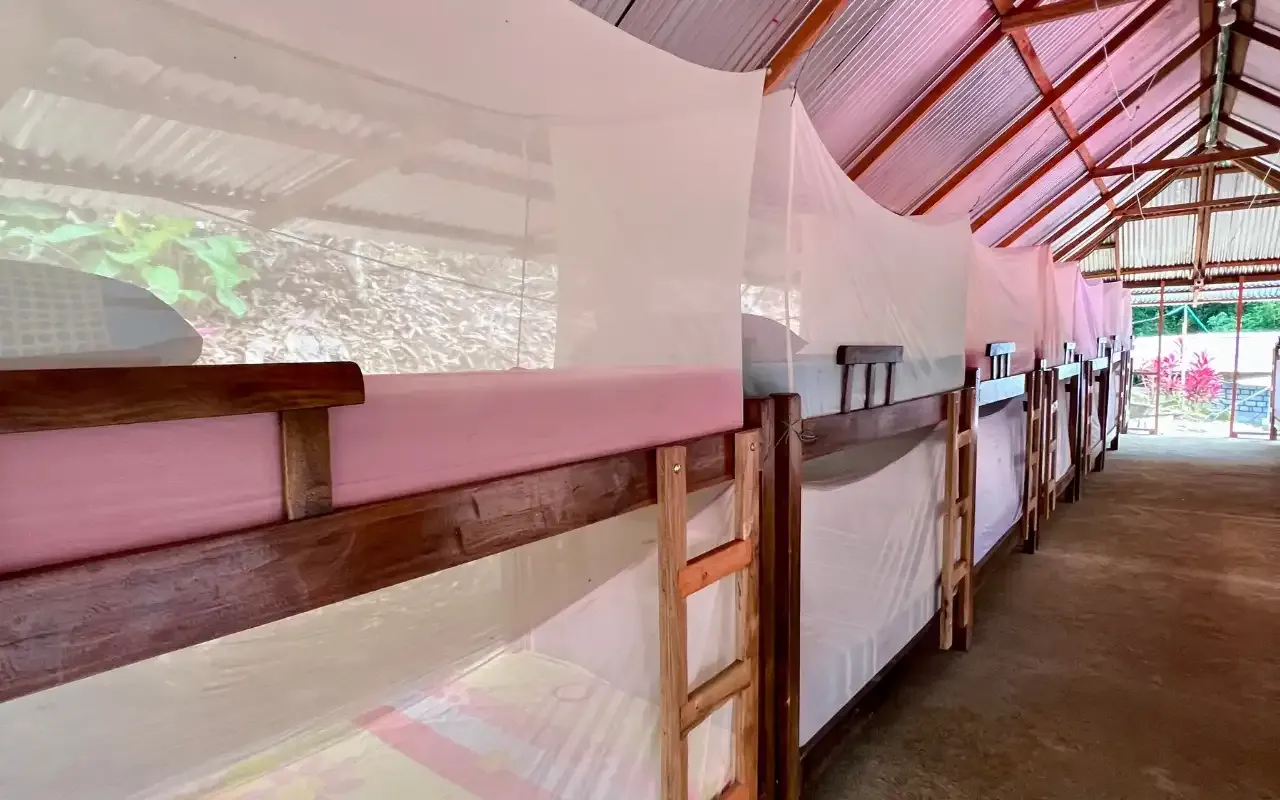
At jungle camps — Adán and Teyuna on the 4-day route. Open-sided structures with hammocks and bunks under mosquito nets.
Will I get a bed or a hammock?
It depends on the season and the group. Camps mix bunks and hammocks, and the split shifts with demand. No operator can promise a bed every night — anyone who does is guessing. Ask what the realistic split is for your dates.
What are the bathrooms like?
Shared toilets and cold showers at camp. Basic but functional. Bring your own toilet paper and biodegradable toiletries.
Is there electricity at the camps?
Some camps have light from solar panels, and it is not guaranteed at every one. Never 24 hours. A headlamp is essential.
Can I charge my phone?
Only where a camp has solar power, and outlets are few — often one per dormitory area. Bring a 10,000+ mAh power bank and do not count on charging.
Is there wifi or phone signal?
Essentially none. Signal disappears after El Mamey, with occasional weak spots that are not reliable. Download maps and send messages before you leave.
What is the food like?
Full board at camp: rice, beans, plantain, chicken or fish, soup, eggs, arepas, fruit and snacks. Trail lunches are eaten mid-hike on the long days.
Can you cater for dietary restrictions?
Vegetarian is routine — tell us when you book. Severe allergies need to be communicated clearly; camp kitchens are camp kitchens, not restaurants with isolated preparation. Gluten-free is harder than vegetarian out there.
Is the water safe to drink?
You can refill drinking water at the camps. Carry 2–3 litres of capacity between stops in the heat.
What animals will I see?
Howler monkeys near Adán, toucans and hummingbirds in the canopy, insects at camp. Jaguar and tapir exist but are very rarely seen — tracks in mud are far more common. Do not feed the camp dogs.
How heavy is my backpack?
8–10 kg including water and rain gear. A pack mule can carry more for a fee, arranged on request when you book.
What shoes should I wear?
Trail runners that drain and dry beat waterproof boots that fill up. Break them in before you come, and bring a second pair of socks for camp.
Can I leave luggage in Santa Marta?
Yes — at your hotel or at our office. Only your daypack goes on the trail.
Are drones allowed?
Yes, but only with advance notice. This is indigenous territory inside a protected archaeological zone, so permission is not automatic and it is not ours to grant. Tell us when you book and we will find out whether your dates work. Turning up with one and asking on the trail gets a no, and flying it anyway risks confiscation and a fine.
Can I photograph indigenous people?
Ask first, every time. Photography rules matter on this trail, and modest dress near villages is expected. See the indigenous communities guide.
What happens if it rains?
The trek runs in all conditions and the operator does not cancel for rain. Rain is common May to November: trails turn to mud, river crossings swell and the final descent is slower. Bring a real rain jacket, two dry bags and quick-dry clothing.
What if I cannot finish?
Evacuation is on foot or by mule to road access — slow and weather-dependent. There is no hospital on the trail. Trek insurance for the hiking days is included; international travel insurance with medical evacuation is separate and worth having. Tell your guide early if something is wrong.
Is the Lost City trek safe?
On authorised departures, yes. The real risks are heat, river crossings and slips — not lawlessness. Follow your guide at crossings, unbuckle your hip belt before entering water, and report problems early.
When is the best time to go?
Any month except October. December to March is drier with firmer trails and busier camps; April to November is greener with fewer people and more mud. See best time to visit.
Why is the site closed in October?
From 1 to 31 October every year the archaeological zone closes for indigenous spiritual and environmental restoration. The decision belongs to the four communities that own the territory, not to any operator, and it is not negotiable. If a site sells you an October departure, it is not authorised.
Can I hike to the Lost City without a guide?
No. The trail crosses indigenous territory and the site is only reachable with an authorised operator and guide. There is no independent permit and no self-guided option.
How do I know an agency is actually authorised?
Several agencies hold the licence, all at the same rate. Check the price against it, ask for the RNT number, look for a physical office in Santa Marta, and ask the agency to name its guides — whoever does not employ them cannot. See how to choose an operator.
Is the Lost City worth it?
For anyone willing to be uncomfortable for four days, yes. It is one of very few major archaeological sites still reachable only on foot. Read the honest case for and against.
Ready to walk it?
Departures leave Santa Marta at 7:00 a.m. every day. The 4-day trek has no minimum group — it runs whether you are five people or one.
From COP 1,860,000 4 days — the classic