These are not competing versions of the same trip. Machu Picchu is a site you visit; the Lost City is a walk that ends at a site. If you only have the appetite for one, that difference decides it faster than any comparison table will.
The short version is that Teyuna was founded around 800 CE, roughly 650 years before Machu Picchu, sits far lower, receives a fraction of the visitors, and can only be reached on foot. Machu Picchu is more spectacular to look at, easier to reach, and much busier.
Side by side
| Lost City (Teyuna) | Machu Picchu | |
|---|---|---|
| Country | Colombia | Peru |
| Founded | ~800 CE | ~1450 CE |
| Altitude | ~1,209 m | ~2,430 m |
| How you arrive | On foot only — 4 days, 60 km | Train, bus, or the Inca Trail |
| Visitors | A fraction | Thousands per day |
| Altitude sickness | Not a factor | A real consideration |
| Main difficulty | Heat, humidity, repetition | Altitude |
| Time needed | ~1 week in the region | Can be done in 2 days |
| Closed | All of October | Open year-round |
When Machu Picchu is the better choice
We would rather you enjoy the right trip than book the wrong one with us.
- You have limited time. Machu Picchu can be a two-day trip from Cusco, while the Lost City cannot be done in less than four days on foot plus a recovery day.
- You have mobility limits. There is a bus to the Machu Picchu gate. There is no vehicle alternative anywhere on the Lost City route, and no way to shorten the 1,200 steps.
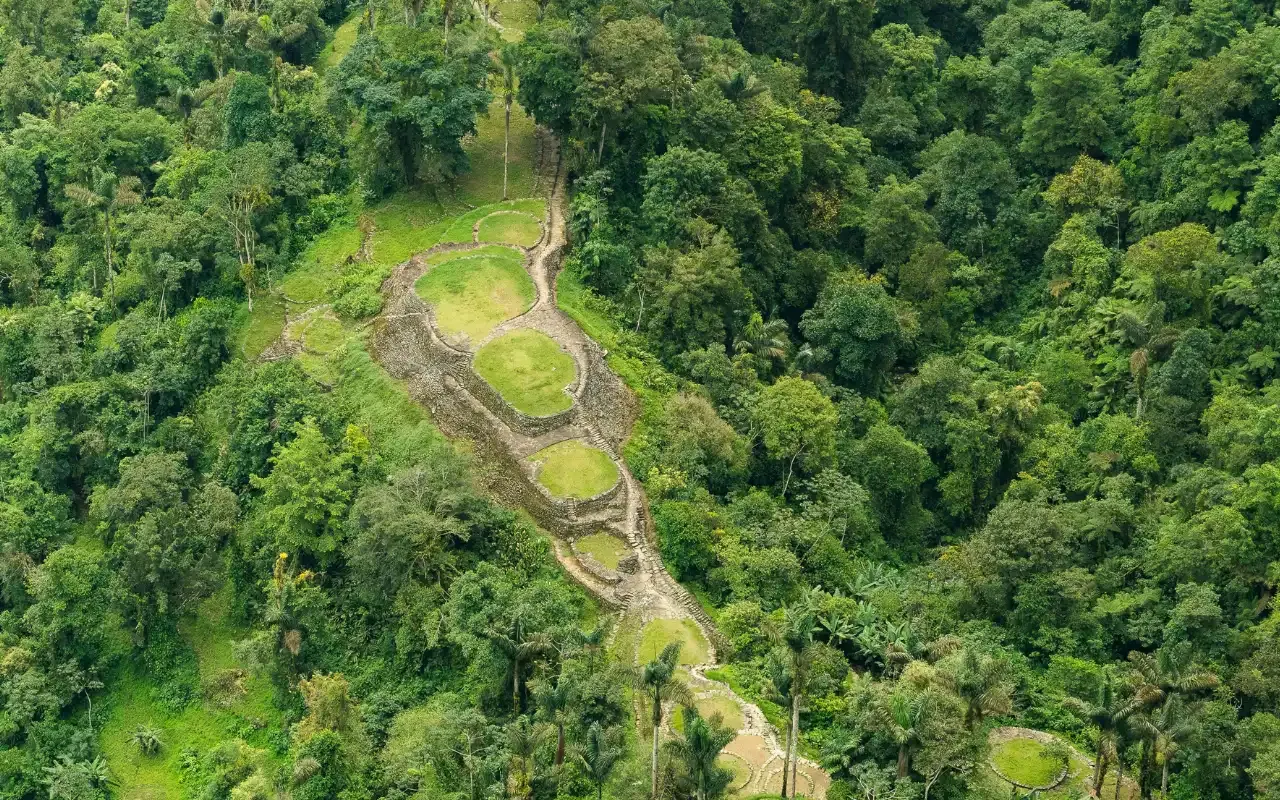
- You want the photograph. Machu Picchu has the more dramatic skyline and it is not close. Teyuna is terraces in forest, beautiful in person and less spectacular in a frame.
- You want comfort at the end. Aguas Calientes has hotels and restaurants; the Lost City has a jungle camp with cold showers.
None of that costs us anything to say, because these are different countries and different trips. Many people do both across one long South America journey.
When the Lost City is the better choice
- You want the arrival to be earned. You walk 60 km and climb 1,200 stone steps to reach Teyuna, and nobody arrives by train.
- You dislike crowds more than you dislike effort. The multi-day walk filters the visitors before you get there: Machu Picchu manages crowds with timed tickets, the Lost City manages them with four days on foot.
- Altitude worries you. At roughly 1,209 m there is no acclimatisation, no altitude sickness and no thin air, while Machu Picchu’s 2,430 m — and Cusco’s higher still — is a genuine planning factor.
- You want people, not just stone. The trail crosses territory still owned and governed by the Kogui, Wiwa, Arhuaco and Kankuamo, the descendants of the people who built it. You walk past homes, not exhibits.
- You want it cheaper. The Lost City is COP 1,860,000 all-inclusive for four days: guiding, transport, all meals, camps, park entry and trek insurance.
The age difference is the interesting part
Teyuna predates Machu Picchu by around 650 years. The Tayrona were building terraced cities in the Sierra Nevada from about 800 CE, while Machu Picchu went up around 1450, near the end of the Inca period, and was abandoned within roughly a century.
Teyuna was never abandoned in the same sense. Spanish conquest and the epidemics that followed broke the network connecting it to the coast, and the survivors moved higher into the Sierra — but their descendants never left the mountain range and never lost the knowledge of the place. It was looted in 1972, not discovered.
What the two treks actually ask of you
The Inca Trail asks for permits and fixed dates, roughly 43 km of walking, an altitude of up to about 4,200 m, and cold nights.
The Lost City asks for none of that, and for other things instead: no permit you can buy yourself, daily departures, 60 km on the 4-day, a maximum of around 1,209 m, 28–32 °C and humidity, and river crossings on foot.
So if you have done the Inca Trail and are wondering whether the Lost City will feel easy, it is a different kind of hard. Lower, hotter, wetter, and the last day is a 17.2 km descent that surprises people. There is more in the difficulty guide and in Lost City vs the Inca Trail.
Doing both
Plenty of travellers do, usually months apart. If you are planning both in one trip, three things are worth knowing.
- Do the Lost City first if you want the harder walk while you are freshest, but note that it is at low altitude, so it does not prepare you for the Andes.
- October matters. The Lost City is closed 1–31 October and Machu Picchu is not, so if your dates are fixed in October, that decides it — unless what you wanted was the Sierra, in which case Bunkuany walks all month.
- Different permits, different countries. Nothing you arrange for one applies to the other.
The honest summary
Machu Picchu is the better site. The Lost City is the better trip, if you want the journey to be the point.
Choose Machu Picchu for Inca architecture, a dramatic setting and moderate effort. Choose the Lost City for four days in the forest, an archaeological site you have almost to yourself, and a walk through territory whose owners decide who enters.
Other comparisons
- 3 vs 4 vs 5 days — the duration, and why the 4-day is the cheapest
- Lost City vs the Inca Trail — heat against altitude
- Lost City vs Tayrona — same name, two places
- Lost City vs Cocora Valley — two travel days apart, not an either/or
Related
- Is the Lost City trek worth it? — the honest case for and against
- Lost City trek difficulty — day by day, with real numbers
- History of the Lost City — from 800 CE to the 1972 looting
Ready to walk it?
Departures leave Santa Marta at 7:00 a.m. every day. The 4-day trek has no minimum group — it runs whether you are five people or one.
From COP 1,860,000 4 days — the classic