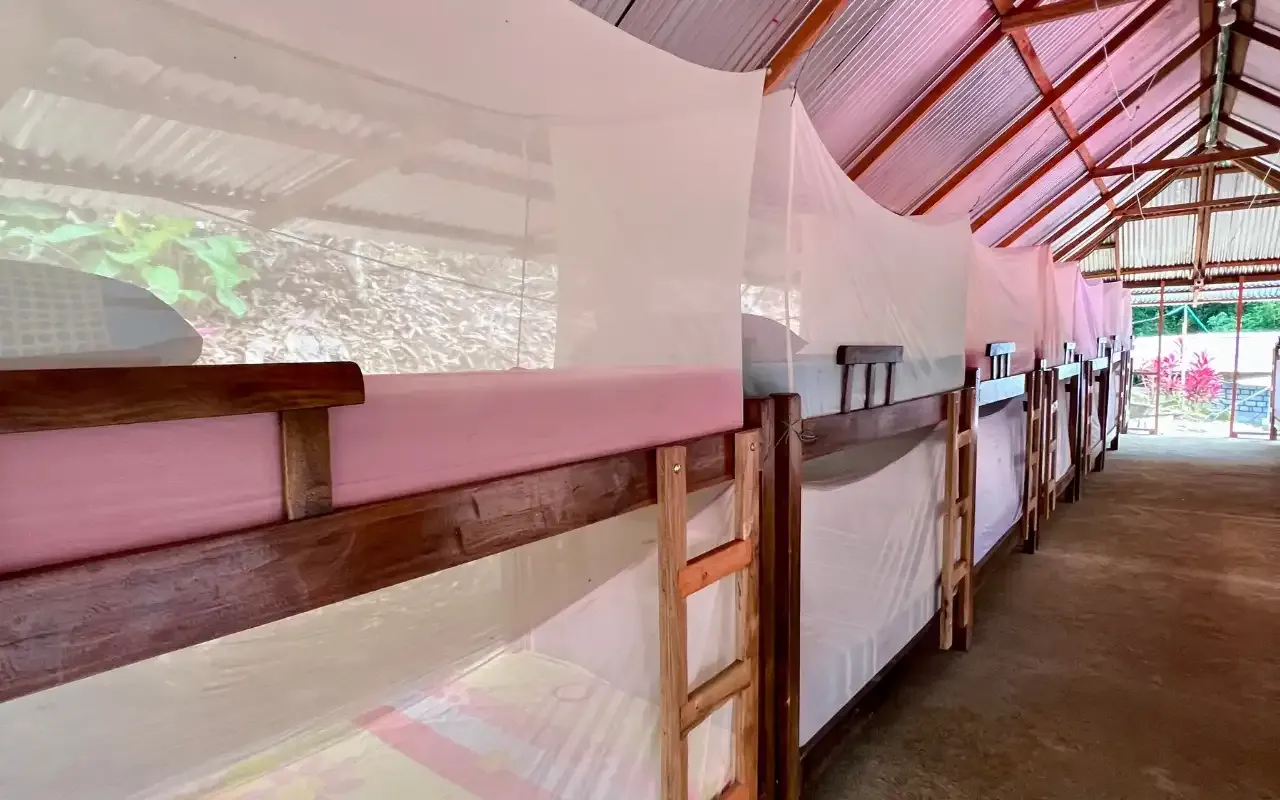
You sleep in open-sided jungle camps, in a hammock or a bunk, under a mosquito net, and no operator can promise you which one. That last part is the answer most people are really looking for, so it goes first.
The camps come in pairs, and you sleep at one of each pair as you go up the valley: Adán or Alfredo on night one, Paso Lorenzo or Paraíso on night two, Múmake or Wiwa on night three. The 5-day adds a fourth night, out on the waterfall route. Which one of a pair you get depends on the departure, so ask us for your dates and we will tell you. Same camps for every authorised operator; nobody has a better version.
Hammock or bunk?
Camps mix bunks and hammocks, and the split shifts with season and demand. In the dry months from December to March the camps are fuller and your odds of a bunk drop. In the wet months they improve.
Anyone who guarantees you a bed every night is guessing. Ask what the realistic split is for your specific dates — of us, and of anyone else you are considering. It is one of the better tests of whether an agency answers questions straight.
If you have never slept in a hammock, most people sleep worse the first night and fine the second. Lying slightly diagonally rather than straight along the axis makes a large difference.
What the camps actually are
Open-sided wooden structures with a roof, hammocks and bunks hung in rows, and mosquito nets over everything. Not tents. Not cabins with doors.
You are provided with a hammock or a bunk, a mosquito net, a blanket and a basic mattress on the bunks. You are not provided with a towel, toilet paper, hand sanitiser or a pillow worth the name.
What you do not need is a tent, a sleeping bag, a sleeping mat or a water filter. Every one of those is weight you would carry for nothing.
Bathrooms and showers
Shared toilets and cold showers, basic but functional and cleaned. Bring your own toilet paper and biodegradable toiletries, because nothing is supplied.
The showers are cold because there is no water heating anywhere on the trail. After 17.2 km in 30 °C humidity, this turns out not to be the hardship it sounds like.
Electricity, charging and signal
Some camps have light from solar panels, and it is not guaranteed at every one. Outlets are few, often one per dormitory area.
Bring a power bank of 10,000 mAh or more and treat charging as a bonus rather than a plan. A headlamp is essential rather than optional, because summit morning starts before dawn.
There is essentially no signal and no wifi. It disappears after El Mamey, with occasional weak spots that are not reliable. Download your maps and send your messages in Santa Marta.
Food and water at camp
Full board runs from lunch on day one: rice, beans, plantain, chicken or fish, soup, eggs, arepas, fruit and snacks. Vegetarian is routine if you tell us when you book, while gluten-free is harder out there than it is in the city.
Treated water for refills is provided at every camp, so you need to be able to carry two to three litres between stops rather than to purify anything yourself.
Some camps sell beer. It is not included, and it is priced by the camp rather than by us.
What the nights are like
They are not cold. This is a tropical mountain range and the nights are mild. You will, however, be damp, so something dry to change into at camp matters more than something warm.
The forest is loud. Insects at dusk, howler monkeys at dawn near Adán. The dawn chorus is a genuine part of the trek rather than an inconvenience, though it will certainly wake you.
Camp dogs exist. Do not feed them.
Who else is at the camp
Every authorised operator uses the same camps, so you will share them with other groups. This is not a private lodge experience and was never sold as one.
In practice the groups mix over dinner, and it is one of the reasons solo travellers do well on this trek.
What to bring specifically for camp
- A second pair of dry socks. Dry feet in the evening is a real morale item.
- Sandals or crocs, for camp and for the showers.
- Something dry to sleep in that has been sealed in a dry bag all day.
- A quick-dry towel.
- Earplugs, if you are a light sleeper. The forest and the other group both make noise.
The full list is in the packing guide.
Does the 5-day change where you sleep?
It does. It adds a camp at the end of the route, with more time in camp and in conversation. The first three nights are the 4-day’s. The 3-day sleeps at two of the three, skipping Adán and starting further up.
What does not change on any duration: hammock-or-bunk, cold showers, shared toilets, no signal.
Related
- What to pack — including what camp specifically needs
- Food on the Lost City trek — what you eat and when
- 4-day itinerary — which camp on which night
- Lost City trek price — what accommodation is included
Ready to walk it?
Departures leave Santa Marta at 7:00 a.m. every day. The 4-day trek has no minimum group — it runs whether you are five people or one.
From COP 1,860,000 4 days — the classic