Yes, on an authorised departure. And the risks that actually send people home early are heat, river crossings and slips rather than crime.
That reordering is the whole answer, really. Most people arrive worried about the wrong thing entirely.
The question behind the question
If you have read about Colombia’s past, you are probably asking about security rather than about mud. It is a fair question and it deserves a direct answer rather than a marketing one.
The Lost City corridor today is a regulated tourism route. Access runs through authorised operators only, under an arrangement with ICANH and the four indigenous peoples who own the territory, and nobody walks it independently. There is an army presence in the area and checkpoints on the drive to El Mamey are routine, which surprises some visitors and is simply part of how the corridor is administered.
What we will not do is pretend the region has no history. It has one, and travellers find it. What is also true is that the trek has run continuously as a regulated route for many years, with walkers on it in every season, and that the day-to-day risk profile now looks like any tropical multi-day hike: weather, water, and your own legs.
The risks that are actually real
Heat and dehydration head the list. It is 28–32 °C with high humidity every single day, and heat exhaustion is the most common avoidable problem out there. Carry two to three litres of capacity, drink before you feel thirsty, and take electrolytes rather than water alone on the long days.
River crossings come next. You cross on foot, and after rain the water rises. Your guide decides where and when, and that decision is not a formality: the crossing point genuinely moves with the water level.
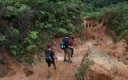
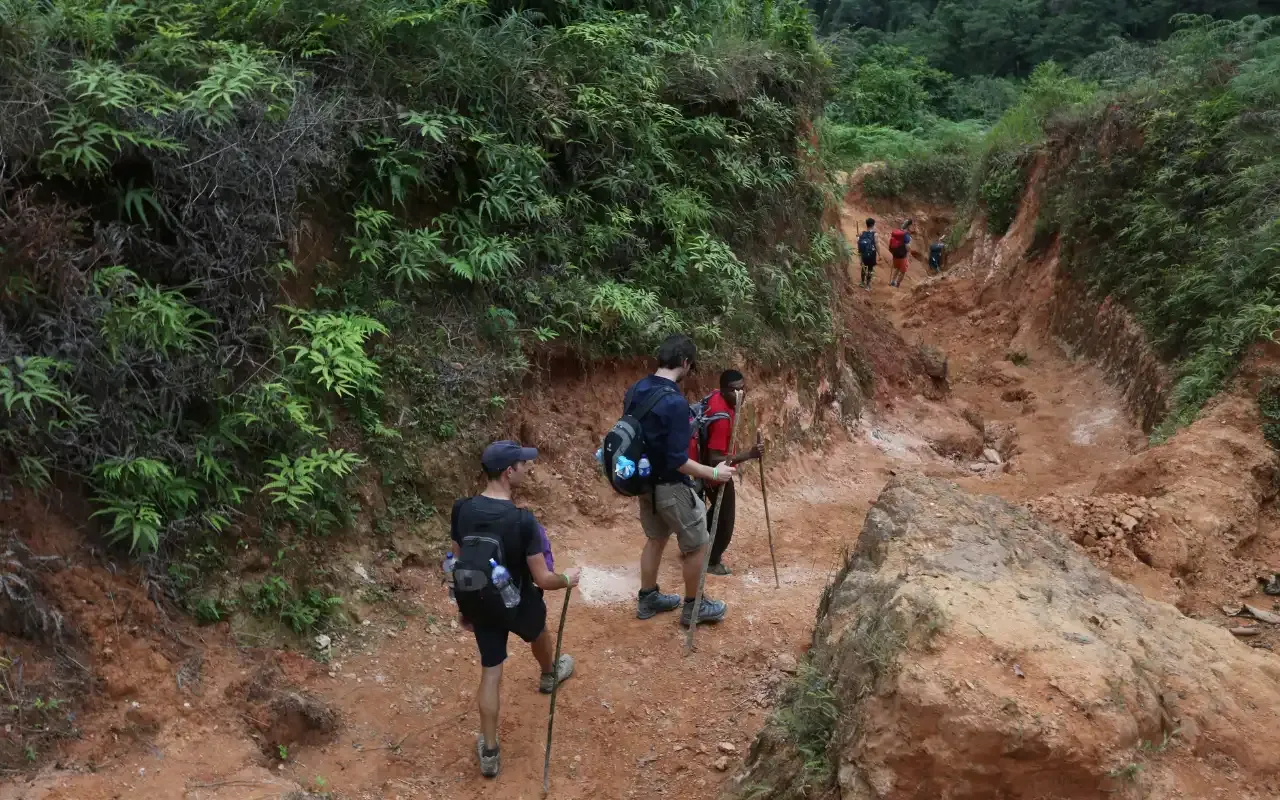
Then there are slips. From May to November the trail is mud, and the long descent on the last day is where most falls happen. Poles help more than anything else you can carry.
Blisters sound trivial and are the single most common reason people struggle. Report one at kilometre three and it is a blister; report it at camp and it is tomorrow’s problem. Insects round out the list — mosquitoes at dusk, especially around camp, so bring repellent and long sleeves.
What your guide controls
- Where and when you cross water. Wait for the call, and do not pick your own line because it looks shallower from where you are standing.
- Pace. Groups walk together, and the pace is set for the group rather than for the fastest person in it.
- When to stop. If your guide says you are drinking too little or moving badly, that is not a suggestion.
- What is off-limits. Some places are off the path because they are sacred rather than hazardous. Both reasons produce the same instruction.
One practical habit is worth learning before you go: unbuckle your hip belt before you step into water. If you go over, you need the pack to come off.
What happens if you get hurt
This is the part worth knowing before you book, and it is the same for every operator on the trail.
There is no hospital out there. Guides carry basic first aid, and serious injury means a coordinated evacuation on foot or by mule to road access, which is slow and weather-dependent.
Trek insurance for the hiking days is included in the price. International travel insurance with medical evacuation cover is a separate thing entirely, it is not included, and on a trail with no road access it matters more than people expect. Buy it.
And tell your guide early. Dizziness, a blister, a rolled ankle, just feeling off — early is a small problem, late is an evacuation.
Solo travellers and women
Solo travellers join mixed international groups, and this is one of the treks where that works particularly well: four days without phones and the group forms fast. Because our 4-day has no minimum group size, a solo booking does not sit waiting for other people to fill the departure.
Normal trekking precautions apply and no more than that. Stay with the group, keep valuables in a dry bag, and speak up early if something is wrong.
What “unsafe” actually looks like here
Almost every genuine problem on this trail comes from the same short list of behaviours:
- Leaving the group to swim alone in a river.
- Ignoring the guide’s call at a crossing.
- Pushing on through heat symptoms rather than saying something.
- Flying a drone you did not clear in advance. It can be arranged, but not on the spot, and flying one without permission risks confiscation and a fine.
- Photographing people in the indigenous communities without asking.
None of those is bad luck. All of them are choices.
Before you book, ask any operator
- Is my departure confirmed or provisional?
- What is your evacuation procedure, what does it cost, and who decides?
- What is the realistic bed-to-hammock split for my dates?
- What is your maximum group size, not the average?
An operator that answers those plainly is telling you something useful about how the four days will go. One that is vague is telling you something too.
Related
- Lost City trek difficulty — the days that cause the problems
- What to pack — including the first-aid kit that matters
- How to choose an operator — how authorisation works
- Indigenous communities on the trail — the rules and why they exist
Ready to walk it?
Departures leave Santa Marta at 7:00 a.m. every day. The 4-day trek has no minimum group — it runs whether you are five people or one.
From COP 1,860,000 4 days — the classic